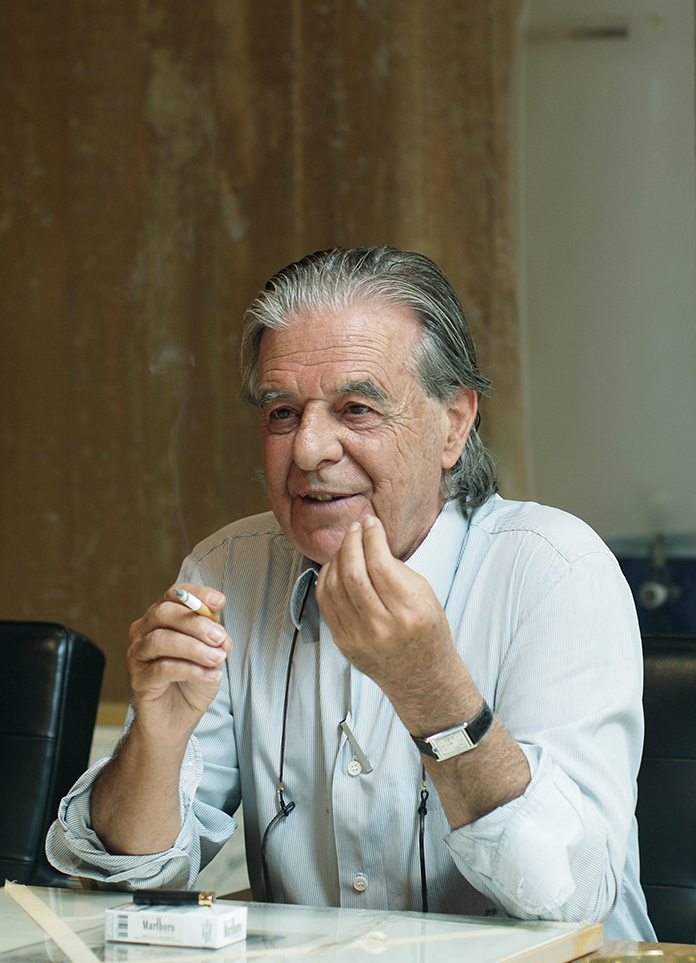
In contemporary architectural practice, the question of how to engage with site, time, and ways of dwelling has become more significant than form itself. Designed by Atelier Carle, a Canadian architecture studio, SONO Residence emerges from precisely this line of inquiry. In our conversation, Atelier Carle explained that their work is grounded in a deep engagement with the relationship between architecture and the realities of its environment, rather than in any predetermined stylistic language. For them, architecture is not an object placed upon a site, but a medium that connects perception, landscape, and lived experience. In this sense, SONO feels less like a conventional house and more like an exploration of what it means to inhabit a place.
Atelier Carle also believes that contemporary architecture can no longer be realized through a linear process led solely by the architect. Instead, it requires long-term and meaningful collaboration among architects, craftspeople, builders, and clients. From the development of the timber structure to the sourcing of local materials and the evolution of construction methods on site, every decision within SONO emerged through continuous dialogue and collective creation. This trust-based approach ultimately shaped a residence that integrates gently with its natural surroundings, responds to the passage of time, and achieves a subtle balance between openness and privacy.
This secondary residence organically articulates a unified composition, oriented toward northern light, framing landscapes found within a vast panorama that opens onto the site.
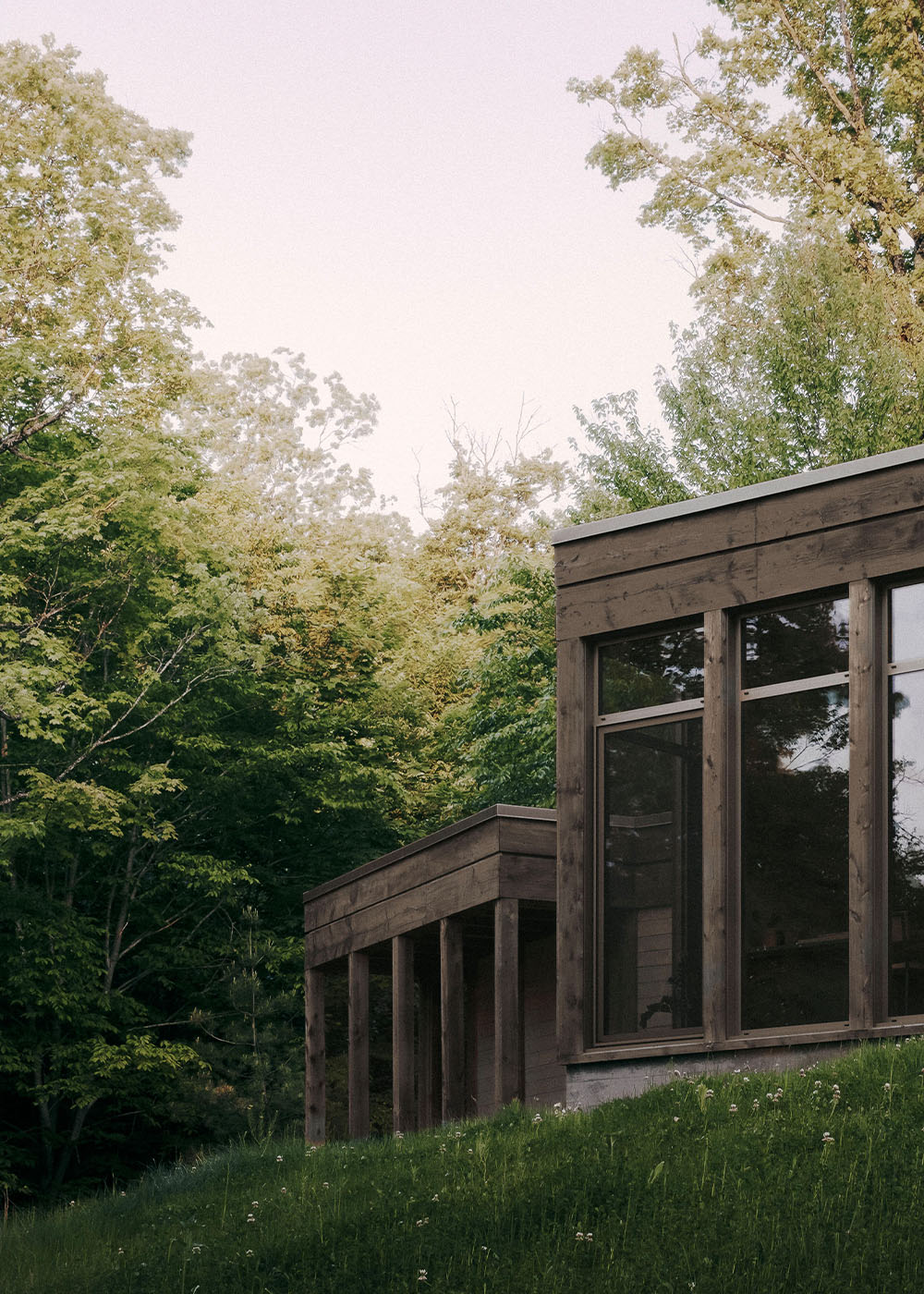
Three long concrete walls of varying heights, in scale with the landscape, form the approach to the building. They resonate with the permanence of the now-architectured site and anchor it in time. A narrow gap between the walls reveals the entrance.
Beyond this threshold, the spaces organize the living areas according to a flexible layout and timber structure, thereby signaling their capacity to adapt over a more distant temporal horizon.
The clients, a couple of friends wishing to share the same secondary residence, had an implicit directive: to share a space without being obliged to “live together” in every respect. The articulation of the architectural volumes thus creates a meandering sequence of spaces that gradually reveal the whole, ensuring a certain visual intimacy and a fragmentation of the acoustic environment. Sign of the times, the kitchen is the space that opens completely onto the landscape: a gathering place, both for the couple and their guests, and metaphorically, with the surrounding natural environment.
The conceptual framework of the project is therefore not based on stylistic or identity-related architectural references of the region. Rather than prescribing specific uses, it weaves connections between the body’s in situ perception of the landscape and the real, and that of the space that “frames” experiences across the variations of time.
This refers to the intention to promote a practice that prioritizes the phenomenological qualities of space, rather than being determined by a calculated assembly of programmatic components. The spaces unfold in terraces following the natural slope of the site.
The varied viewpoints revealed within each room, together with the shifting qualities of the indirect light, constitute the haptic characteristics which, like the large abstract wall abutting the landscape upon arrival, are the result of the sensitive exploration advocated by the firm. The outcome is an architectural language that responds to the heterogeneity of the real, rather than constructing a rigid identity derived from often exclusive precepts.
公开 不公开