In our conversation with Bada Studio, they told us: “Architecture that truly belongs to the tropics is not about endlessly pursuing openness and visual transparency, but about responding to the atmosphere of the land itself. We have always hoped that architecture could feel as though it had always existed on the site — coexisting with nature rather than dominating it.” As a result, in the design of Rumah Lituhayu, the studio did not attempt to occupy the site with a single massive volume. Instead, the house was divided into five pavilions dispersed throughout the forest, allowing the architecture to grow naturally alongside the sloping terrain, trees, and river.
This approach also redefines the everyday relationships within a holiday home. Bada Studio believes that the most compelling aspect of traditional Balinese compounds lies in the relaxed yet intimate connection between people, nature, and family life. Through the dispersed bedroom pavilions and the communal space positioned at the centre, Rumah Lituhayu establishes a rhythm of living that moves between solitude and gathering. Shade, river sounds, wind, and covered walkways together form the true spatial order of the house, giving the architecture a quiet, restrained atmosphere deeply enveloped by nature.
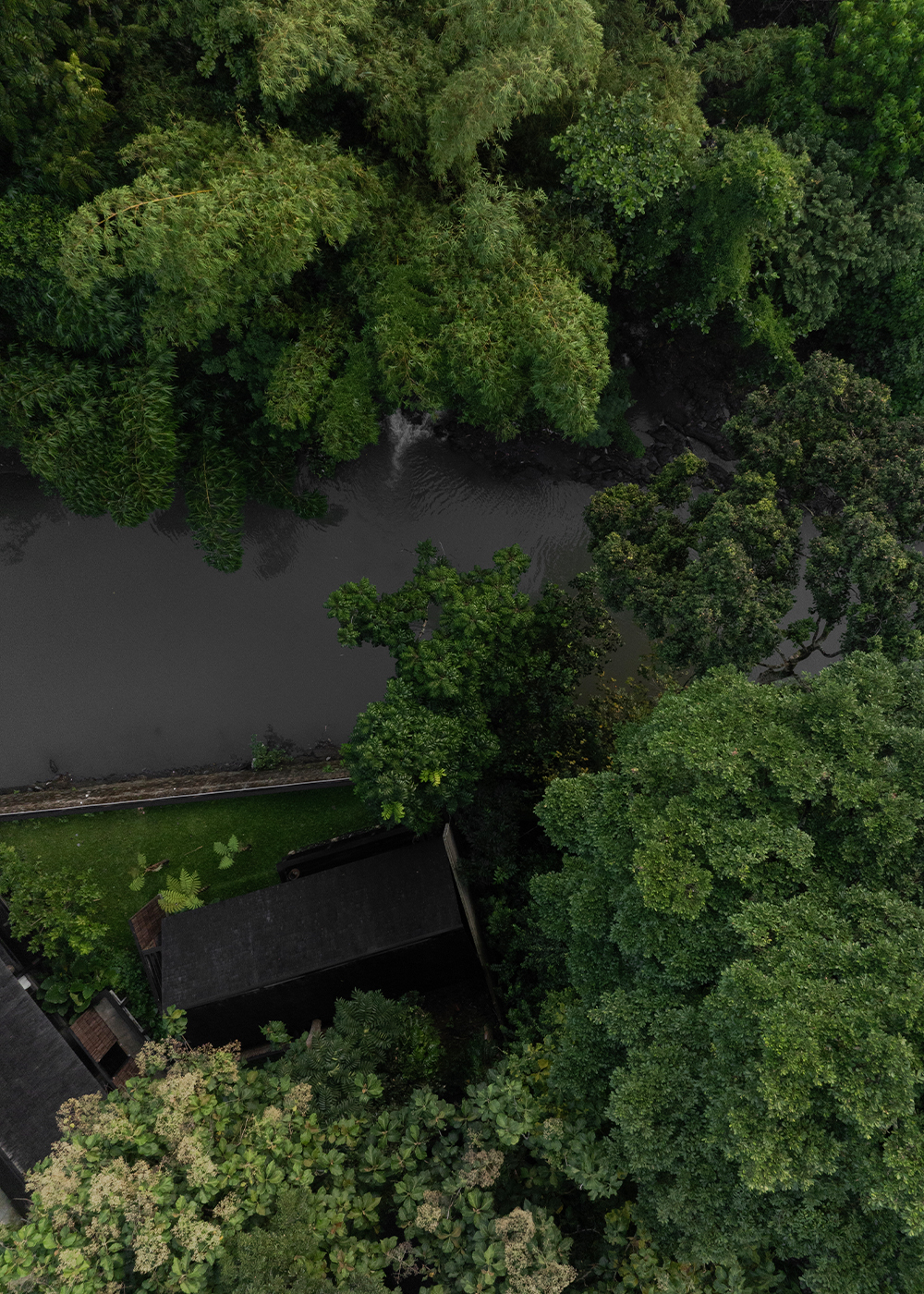
Taking inspiration from the traditional Balinese housing compound and Indonesian stilted homes, Rumah Lituhayu is a holiday home composed of five distinct pavilions. This design approach preserves the natural landscape by elevating the structures above the ground, creating a sense of floating—almost like a collection of treehouses designed for both private and communal living.
The main pavilion houses the communal areas, including the kitchen, dining, and living room, within an open, wall-less space. Tall wooden columns and fully openable walls make the garden an integral part of the interior experience. Its gabled roof extends outward, lowering at the edge to provide shade while also sheltering the corridor below. Positioned at the center of the land, this pavilion faces the river, sitting above the swimming pool, with the four-bedroom pavilions arranged around it.
The bedroom pavilions create a dynamic interplay of spaces, each offering a different perspective of the surroundings. Some are oriented perpendicularly to the river, while others face the gardens or are angled to frame views of the jungle. Inside, the beds are positioned at the front, opening to terraces with views of the jungle and river, while the bathrooms are placed at the rear for privacy.
Carefully distributed across the site, the pavilions adapt to the natural topography, allowing the landscape to remain largely untouched. A dark-toned material palette and burnt sipar wood was intentionally selected to minimize the buildings' visibility within the forest. Mature trees covering the steeply sloping land provide a naturally shaded ambiance throughout the day.
Rather than clearing the site, the design integrates around these trees, preserving each one. In some instances, trees pass directly through the structures, reinforcing the connection between nature and the built environment.
公开 不公开