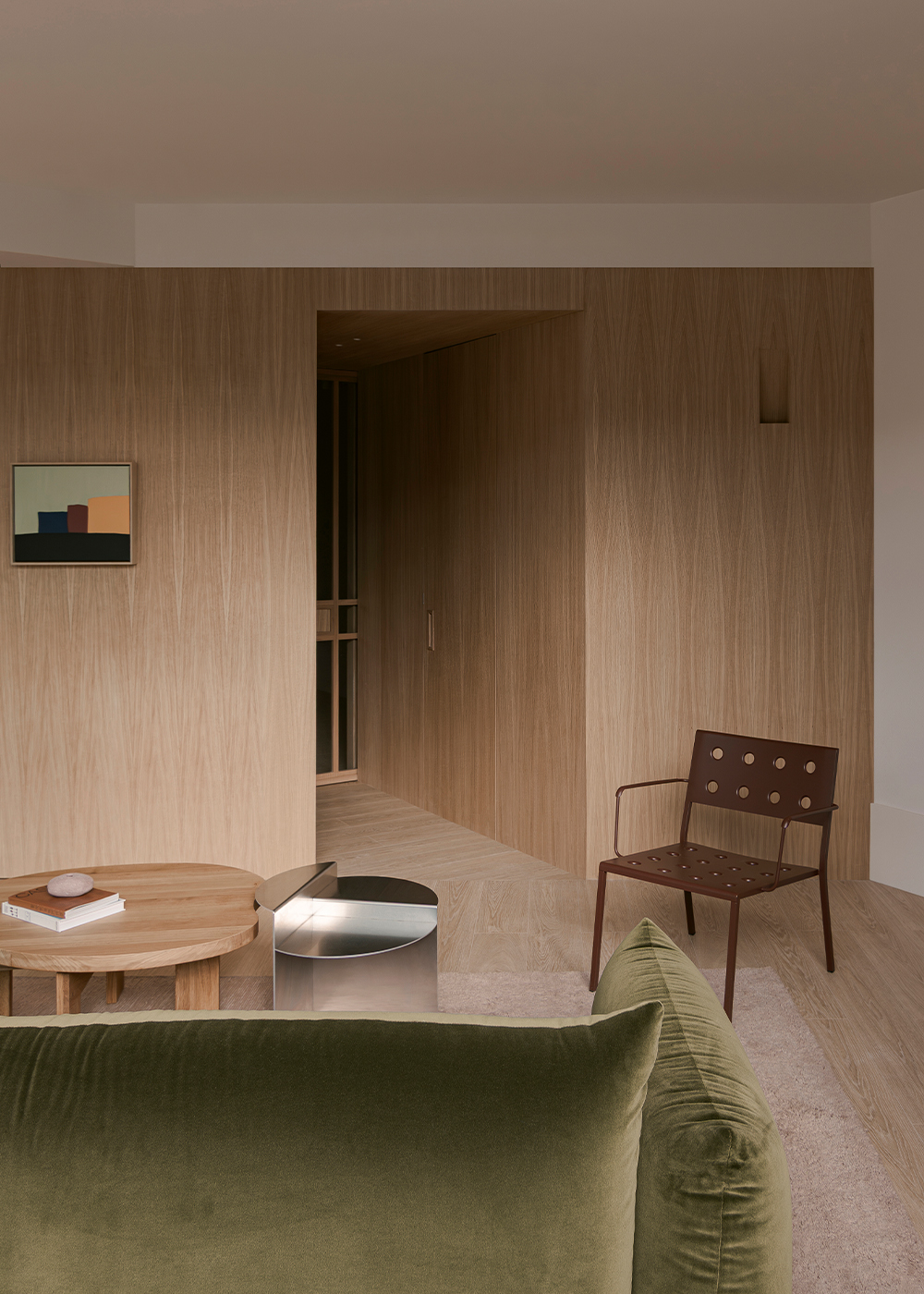
The dwelling is a top-floor penthouse of 88 m² plus terrace, set on an irregular floor plan with few structural constraints. The intervention transforms this broken geometry into a legible sequence through a single organising element: a joinery piece that structures the home beyond conventional partition.
The programme is divided into two zones. The social area is conceived as the first encounter with the space — the living room opens onto the terrace as a perceptual extension, alongside the dining area and kitchen. The private zone is located at the rear, with a guest bedroom and, at the end of the sequence, the main bedroom with a dressing room along the access corridor, both connected by a hallway.
The joinery — resolved in vertical-grain oak with a warm tone — is not used merely as cladding, but as a system: it defines planes, absorbs storage units, integrates flush doors and creates thresholds. This continuity allows the irregular floor plan to be unified and technical elements (services, storage, fittings) to be concentrated within precise, controlled components.
The living room opens onto the terrace through a generously proportioned opening that reinforces the idea of the exterior as a complementary room. The terrace is configured as a bright, uncluttered plane, with a linear planter that introduces vegetation as a backdrop for the interior. This backdrop is resolved with a neutral image — pale walls and a continuous floor finish — that enhances the inside–outside relationship and returns depth to the views from the living room.