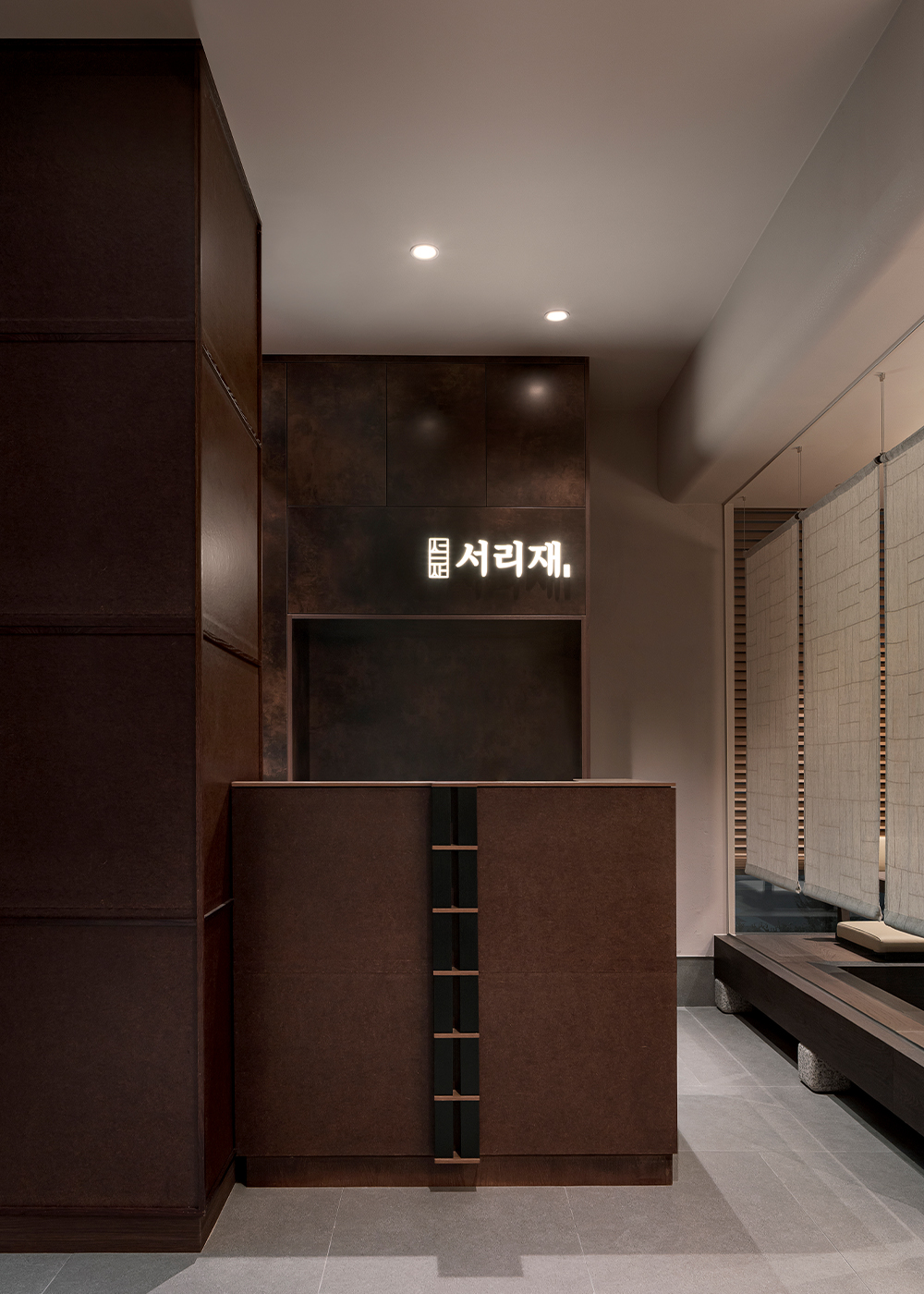
Seorijae is a Korean charcoal-grill restaurant brand rooted in honest ingredients and a sincere approach to fire. Having established its presence mainly in department stores and outlets, the brand opened its first independent street-level restaurant in Bangbae-dong. Located in a quiet, residential neighborhood more familiar with local establishments than chain stores, this decision speaks to where the brand hopes to meet its next generation of customers. At the same time, the project sets out to define a new spatial language for Seorijae.
The first question we asked in this project was not “how should Korean identity be shown?” but rather “how should Korean identity be felt?” While previous Seorijae stores borrowed traditional imagery through the forms of rafters and window frames, the Bangbae branch began by asking what remains when those images are stripped away. The answer was structure, proportion, and emptiness — elements that allow Korean sensibility to be perceived rather than directly displayed.
The space unfolds in sequence: vestibule, hall, semi-private room, and hall. From the street toward the interior, this progression forms a continuous spatial flow. The noise and pace of the outside world are gradually filtered out, and the sense of truly staying within the space is completed only once one is seated. Just as the courtyard of a hanok guides a person through shifting states and purposes when entering a home, the spatial composition of the Bangbae branch reinterprets that experience in a contemporary way.
The finishing materials and objects were selected through a principle of restraint. Reclaimed wood with visible grain is used as a primary material, while objects that evoke Korean forms are placed not as decoration, but as part of the spatial context. Because the space is not filled with excessive elements, the density of what remains becomes deeper. Soft light diffusing across the surfaces helps reveal the natural texture of each material.