Nestled within a dense woodland setting in East Hampton, the home of fashion designer Natalie De’Banco sits in quiet retreat. Reworked by Helena Clunies-Ross Design, it is no longer simply a place for daily living, but a space that allows one to step back from the pace of life and return to a sense of stillness. Expanded by approximately 3,500 square feet, the house opens gradually to the surrounding landscape through expansive glazing, natural materials, and layered textures—allowing a quieter, more enveloping rhythm of living to settle in almost imperceptibly.
“A private wellness retreat rooted in calm.” This was Natalie De’Banco’s clearest intention from the outset. As the founder of Bronx and Banco, she operates within a world of constant visibility and accelerated pace. For her, home needed to offer more than comfort or beauty—it had to absorb physical and emotional expenditure, a place to pause, restore order, and return to balance.
The project therefore did not begin with surface updates, but with a reconsideration of the kind of life the house would hold. Helena Clunies-Ross explains that the brief called for a home that could accommodate both privacy and gathering, while integrating a complete wellness dimension. Natural materials, strong indoor-outdoor relationships, and a layout supporting relaxation, social life, and year-round living became central to the project.
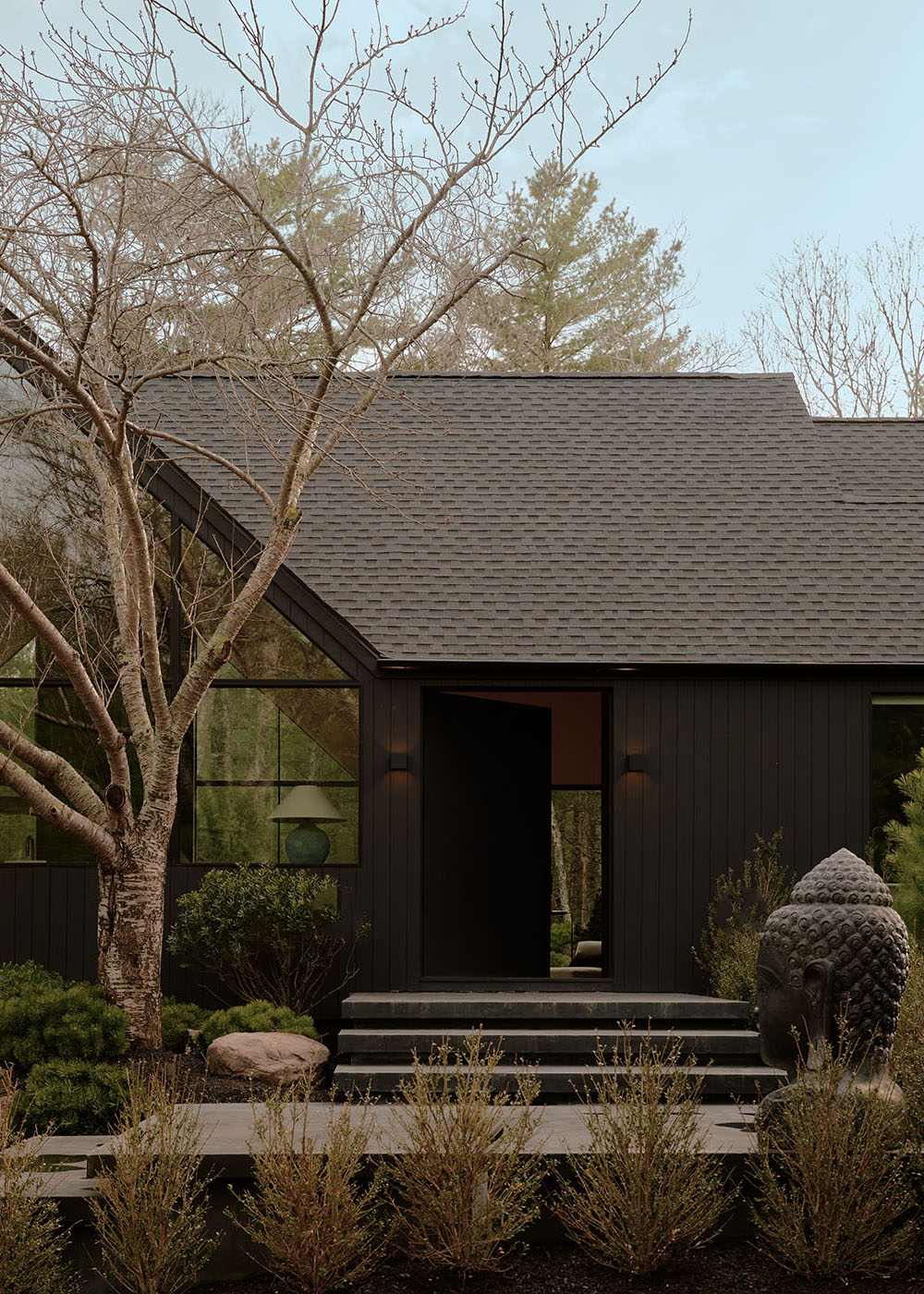
Upon entering, what emerges first is a quiet proximity to nature. Full-height glazing draws the landscape inward, while a preserved mature cherry tree is carefully framed within view—becoming an emotional anchor for the home. Beneath it, floating concrete steps define an entrance that feels restrained and precise. Nearby, the renovated pool and custom Buddha sculptures introduce a softer Southeast Asian resonance, adding a gentle sense of elsewhere within the stillness.
This restraint continues in the interior palette. Greens, browns, and beiges form the foundation, lightly punctuated by black accents. Together with warm woods, artisanal finishes, and carefully selected antiques, they establish an atmosphere that feels grounded and composed. The space does not attempt to perform a “resort-like” mood; instead, a quieter rhythm naturally emerges—one that allows the body to slow down.
Deeply informed by her background in fine art and art history, Helena Clunies-Ross does not rely on decorative accumulation. Her focus lies in how proportion, natural light, materiality, and spatial balance work together to form a clear internal order. She describes this approach as “Calma”—not a style, but a way of allowing space to return to its essence.
This is most evident in the kitchen, where all cabinetry was removed and the space was fully gutted. The introduction of a newly formed peaked window reshapes the room, allowing the landscape to enter more directly into daily life. A bespoke pendant by Helena Clunies-Ross Design brings a quiet sculptural presence. As functional density falls away, the atmosphere becomes lighter, more open, and easier to inhabit.
Timber screens further reinforce this rhythm. They filter light, guide the gaze, and establish a subtle balance between openness and privacy. Stone, wood, and linen introduce a tactile depth that feels immediate and grounded. As one moves through the space, light, texture, and landscape interweave—so that calm is no longer merely visual, but something gradually perceived through the body.
What is most compelling about this residence lies not in any singular sculptural gesture or expressive form, but in its continuous attempt to deepen the relationship between inhabitant and environment: to feel immersed in nature while being gently held within a rational and restrained architectural framework. What ultimately emerges is a quieter, more conscious order of living.
Natalie’s travels in Bali and across Southeast Asia bring an additional layer of sensory depth to the home. Nowhere is this more apparent than in the lower level, where wellness is not treated as an add-on, but integrated into everyday life. The gym, spa, sauna, meditation room, cinema, and speakeasy-style bar are arranged in sequence, allowing the experience to unfold gradually. Here, restoration is no longer an abstract idea, but something lived through daily rhythm.
The use of reclaimed timber and natural materials keeps this level aligned with the rest of the house—warm, grounded, and marked by a sense of time. Eastern sensibilities and modern refinement are not deliberately juxtaposed, but instead come together slowly through daily rituals, bodily perception, and spatial layering.
If the deep connection to the surrounding landscape responds to Natalie’s initial hopes, then Helena Clunies-Ross Design’s reworking of the home ultimately points toward a way of living more closely attuned to her own rhythm. It allows her to step away from the pace of everyday life, to restore energy, and to let creativity emerge quietly within stillness. In this sense, the house is not merely a space that contains life, but one that holds it—maintaining a quiet and steady balance between refuge and inspiration.
公开 不公开