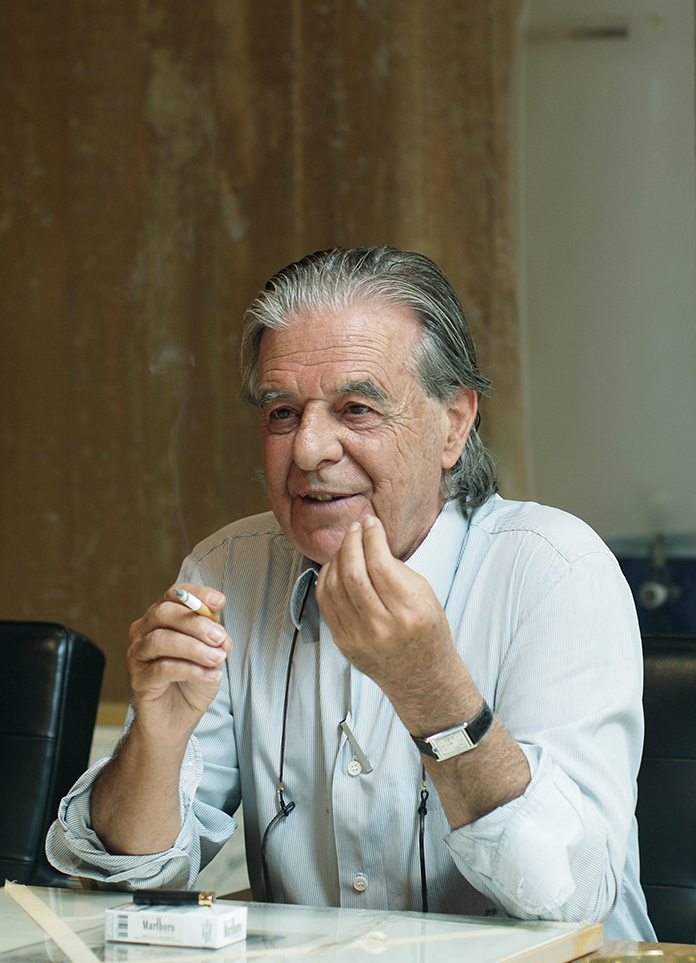
Within the context of Ibiza’s natural textures and layered traces of time, Ibiza Interiors, led on this project by designer Alicia Uldall, redefines Aguamadera through an approach that feels almost restrained. Rather than simply “designing” a resort hotel, the studio sought to awaken a finca long embedded within the landscape itself. As Alicia Uldall told us, they are deeply drawn to spaces that, although buried by time, still preserve the memory of a place — a circular threshing floor hidden beneath layers of earth, stone walls slowly weathered by wind and sunlight, and architectural traces accumulated across different periods, all regarded as the site’s most valuable elements. Rather than erasing these layers, the design preserves the marks left by time while allowing the architecture to return to a state of coexistence with nature through its original structure and spatial order.

For the studio, the true spirit of Ibicencan architecture does not lie in form alone, but in a way of living deeply rooted in the land. Wood, stone, and earth are reintroduced into the space, while earth, fire, air, and water become part of its spatial rhythm and atmosphere. Ibiza Interiors believes that the relationship between people and nature should go beyond simply “framing a view”; nature should be allowed to truly inhabit everyday life. As a result, Aguamadera offers a natural and unforced hospitality experience — one centred on a sense of “return.” Beneath shifting tree shadows, moving air, and slowly changing light, guests are invited to rediscover time itself, while rebuilding a deeper connection with both the land and their inner selves.

In the design of Aguamadera, Ibiza Interiors uses the four elements—earth, fire, air, and water—as a subtle spatial framework rather than a literal expression, guiding the organisation and flow of the architecture. The spaces unfold through a sequence of soft and natural transitions, allowing each area to connect intuitively and creating a calm sense of movement throughout. Materiality plays a central role in the project. Raw textures, muted tones, and natural materials that age gracefully over time shape the tactile and atmospheric quality of the space. At the same time, water and fire are woven throughout the project, introducing light, warmth, and a subtle sense of movement that enriches the sensory experience. The result is a quiet and balanced environment, and gently unifies the different architectural layers added to the property over time.
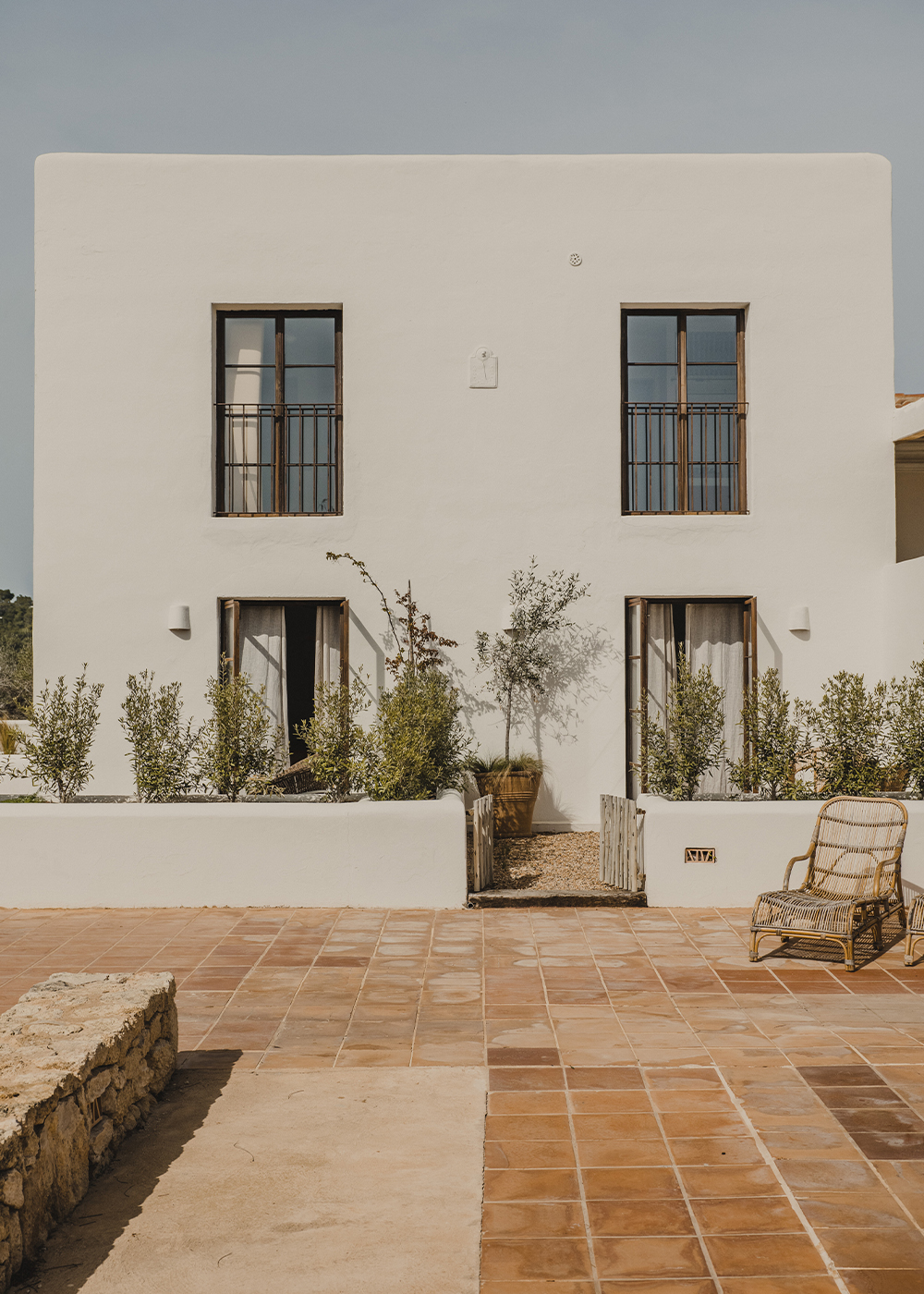
When we discussed with Ibiza Interiors about how they approached the traces left by different periods of the building, they said: “Rather than erasing these layers, we chose to respond to their presence with honesty. We wanted the house to retain its natural sense of time and transformation.” Therefore, based on a careful reorganisation of the existing structure, they preserved elements that respected the original architecture, allowing the spatial volumes to remain faithful to their initial form, while reconnecting the original building with later additions so that they no longer felt fragmented, but instead were rewoven into the overall spatial experience.

At the same time, the entire interior moves toward a more unified sensibility, reconnecting with the essence of Ibicencan architecture—simple, grounded, and balanced. In the design of some annex spaces, however, a more raw and rustic character was intentionally preserved, creating a quiet contrast with the main house while still belonging to the same narrative. For the studio, this sense of unity does not mean erasing differences, but establishing a natural and coherent relationship between the traces left by time.

When speaking about how a space can truly connect with nature, Ibiza Interiors explained that this relationship goes far beyond expansive views or large openings; it is something far more subtle, almost tactile in nature. “The key lies in materiality, in how a space breathes, and how it carries its surroundings within it.” In their view, locally sourced natural materials are especially important—wood, stone, and earth are not merely decorative finishes, but a language capable of preserving the memory of a place, creating a quiet and natural continuity between interior and exterior.

For them, designing in coexistence with nature is not simply about “framing a view,” but about allowing nature to truly inhabit the space. When materials, light, and atmosphere work together, the transition between architecture and landscape becomes effortless and genuine. Traditional Ibicencan architecture is rooted precisely in this relationship between land, nature, and construction. Inspired by this approach, the studio’s design method embraces a holistic vision in which interior and exterior are no longer treated as separate realms, but as parts of one continuous and flowing spatial experience.

From this philosophy, Ibiza Interiors designs in parallel with Ibiza Exteriors, a practice dedicated to crafting outdoor environments that are as intentional, meaningful and integrated as the interiors themselves. Our aim is to honour this connection, shaping landscapes that feel native, effortless and deeply attuned to the architecture and the spirit of the place.

When we asked what kind of rhythm and atmosphere they hoped guests would experience at Aguamadera, Ibiza Interiors responded: “A state of return. Here, the pace is defined by each guest themselves,” they explained. The entire space feels quiet and grounded, deeply connected to nature. It invites people to step away from the urgency and noise of everyday life, and to return to a slower, more authentic sense of time.

MORE PHOTOS