The taste of a home rarely begins with style, or even with space itself. More often, it grows quietly from the way a person relates to the world, gradually taking shape in the place they choose to live.

Danqi is a dancer, a photographer, and a long-time yoga practitioner. Memories gathered through travel, an appreciation for Eastern aesthetics nurtured since she began studying Chinese dance at the age of six, and the quiet simplicity and honesty she discovered through living with plants—all of these became things she hoped to bring into her home. More than a particular style, she wanted to create a life for her children and family that felt both vibrant and deeply at ease.

The painting hanging on the living room wall was completed by Danqi over three days after moving in.

A green with warm yellow undertones—the colour of new shoots just breaking through the soil, still carrying the freshness of moisture and the quiet energy of new life. People often ask whether the painting is finished, or what it is supposed to depict. She simply smiles and says, "Nothing really. I just painted a colour."

What she had really wanted to paint was a mountain—not one with a defined outline, but the quiet continuity of a mountain range, suggested only through the traces left by the movement of the brush. The painting hangs opposite a wall of windows overlooking layers of trees in every shade of green. She wanted it to resonate with the landscape beyond, so that the interior and exterior might seem to breathe together. For Danqi, the painting is, in many ways, a portrait of herself.
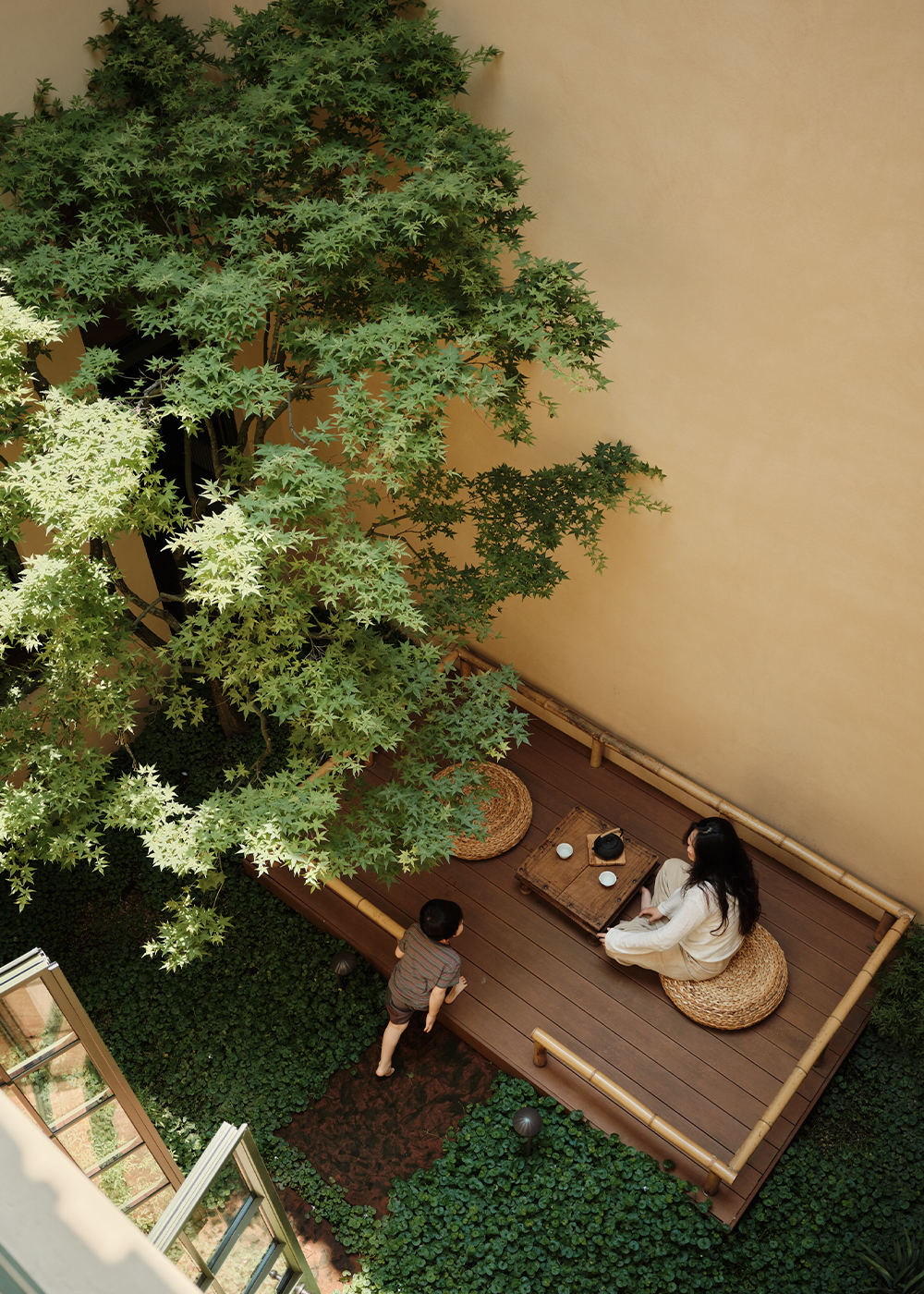
What first drew Danqi to Blue Lake County was not the house itself. At the time, the interior had already been heavily altered, with almost no original structure left to recognize. What truly moved her was the way the house opened outward: “The trees were at just the right distance — close enough to see, but not so close that they blocked the light.”

She has always loved older neighborhoods. The trees have already settled in, the sharp edges of the buildings softened by time and weather, moss naturally growing along the walls. She says, “These traces constantly remind us that we are merely people who appeared at a certain moment in the life of this land. All we can do is appreciate and enjoy what nature has already created.”

The relationship with plants forms an important foundation of the home.

“When you touch the moisture of the soil, observe the shine of a leaf, watch it sprout and bloom — these signals are honest. It feels natural for people to live alongside greenery.”Being with plants makes her feel relaxed and calm. Green is not simply an aesthetic choice or a symbol of vitality, but a relationship — a way of being that she deeply trusts.

The entire home is built around a palette of red and green. To Danqi, red and green feel like a primal combination, something that already exists everywhere in nature.“Red and green make you feel connected to nature, even when you are indoors.”

These ideas also became the starting point for designer Yuan Xinzhi’s understanding of the home, which he translated into a clear design language. He believes that colours should come from either the skin or the earth. The red therefore became a deep terracotta, slightly darker than in his other projects. “Danqi has a bright and joyful personality, so the red needed to feel a little stronger.”Yellow-green represents vitality and growth, so the green became the fresh colour of new leaves. Warm yellow tones soften the transition between red and green, while linen and natural wood ground the palette. The overall saturation remains restrained, creating a sense that everything is just beginning to grow.

The red carries several layers of meaning. One of them comes from Morocco in 2019, during Danqi and her husband Mr. Yang’s honeymoon. Looking down over Marrakech from above, the entire city appeared in terracotta red. Not just a single building, but the whole city.The color did not feel painted on, but as if it belonged naturally to the land itself — as though the buildings had simply grown from the earth, following its color. Sunlight, time, and weathered walls all became part of it.

There is another layer of memory that reaches even further back, into childhood. Danqi began learning dance at the age of six, and later, while studying at the Beijing Dance Academy, she encountered Dunhuang dance. Across the murals, the celestial figures of the flying apsaras move with a sense of wind and rhythm — not in simple reds, yellows, or greens, but in pigments drawn from natural minerals, fused into the rock walls. After thousands of years of weathering, these colors became inseparable from time and space themselves, carrying a depth and patina that deeply captivated her.

Danqi said,“At that time, there was no clear distinction between East and West. There was only openness and exchange — everything was flowing, like a passage.”This was her earliest understanding of Eastern aesthetics: something living, fluid, and constantly evolving.

The deepest layer comes from the red earth of Sichuan and Chongqing. Danqi grew up in Chongqing, where the soil itself carries a warm ochre tone.“If you go back thousands of years, before people became what we now call modern humans, this was the color of the earth beneath their feet when they returned home.”To stand on this color is not only to return to Chongqing, but to return to a more ancient state of being connected to the land.

There is a saying in yoga practice: the body is a vessel for breath. Danqi connects this idea to space itself:“When you cultivate the body, in the end it becomes something that can hold and embrace. Space is the same. It carries your breath, and all those slowly flowing things that unfold while you live within it.”

For designer Yuan Xinzhi, a building must first learn to breathe — not through a single organ, but as a complete living body.This home moves through a deliberate sequence: entry, interior, transitional space, skywell, water courtyard, communal garden — each layer opening and closing in turn, with air, light, and sightlines flowing through uninterrupted. He treats the house as a whole body — skeleton, muscle, skin, emotion — every layer considered with care.

As you enter the home,the plants at the entrance and the terracotta flooring offer a sense of warmth first, followed by a series of arches where light and tree shadows softly shift and overlap.At the center sits the courtyard, where light falls from above and wind moves through, allowing the space to breathe and exchange with nature.

Danqi moved into the home this March. But since the finishing stages of construction last October, she had already been spending almost every day here.The biggest change has been a slower rhythm of life, along with a quiet shift in the way she spends time with family and friends.

Danqi chose curtains that do not fully block the light. When the sky brightens, she wakes naturally. She opens the windows to check the weather, then goes downstairs to water the plants, trim fading flowers, and bring healthy branches indoors.The scent of the home is herbal. The fragrances are carefully chosen — not overly sweet or artificial, but closer to the true smell of plants themselves. Freshly cut branches are casually placed around the house, allowing their scent to slowly spread.Danqi says, “Scent affects emotion in a very direct way. It never lies.”

The relationship between Danqi and Agu has also gradually changed within this home.“There’s less of that feeling that I need to manage or control him as a mother. Our conversations feel more like those between friends. It’s almost like being in a forest — the deer simply does what a deer does, while the rabbit does what a rabbit does.”Everyone has their own place within the home, without trying to control one another.

“Friends come by more often now. Some come to paint, some to write, some say they want to practice yoga — but once they sit down, they no longer want to move, they simply want to stay. When the wind is good, there is a way of living with the wind. When the weather turns hot or cold, each season finds its own rhythm too.”

Agu even gave the pomegranate tree in the courtyard a name — Yang Shiliu, with the nickname Xiao Liu. He has started paying closer attention to its flowering season, waiting for it to bear fruit, and often runs over to say, “Mom, Xiao Liu bloomed again today.”To him, these living things have become part of the family too. The natural environment gently draws more of Agu’s attention, while also giving both him and Danqi more moments to simply pause and let their minds rest.

The transitional grey space on the ground floor is left open between inside and outside. Designer Yuan Xinzhi describes it not as a gap between two opposites, but as a medium that allows both sides to flow naturally into one another. Much like the space between mountains and water, it gently allows people to feel more at ease.Life here is not overly arranged or filled up. Because the space leaves room, many things are able to happen naturally.

People often ask, “What style is this home?” Danqi usually replies, “No particular style — I just like things that feel beautiful. But friends who truly know her never ask that question. They simply say that being here feels comfortable, natural. By then, they have already entered the atmosphere of the home and felt it for themselves, without needing words to define its outer form.

This has perhaps always been part of Danqi’s character—an Eastern sensibility. Rather than expressing herself forcefully, she finds her way, through living with nature, with others, and with everyday life, toward a state that feels calm, expansive, and quietly uplifting.

Yuan Xinzhi has always been creating spaces rooted in a deeply authentic Chinese spirit. In Yuan Xinzhi’s view, Chinese design has never been about symbols or decoration, but about a way of thinking — how one understands the world, organizes space, and responds to the state of human life.Beneath form itself lies a deeper understanding of life, nature, and time.

The feelings and memories Danqi brought into the home — her brightness and sense of joy — became the deepest expression of its character. Through this gradual closeness and mutual understanding, the home slowly grew into what it is today.

MORE PHOTOS