This duplex residence located in Zhengzhou also began with almost the same proposition initially - how to let light re-enter the home. The original layout did not make concessions for light: the staircase was placed in the center of the first floor, dividing the public area into two disconnected sides; the shadows of trees, bamboo, and greenery surrounding the windows stopped at the exterior wall.
The entrustment relationship itself also carries typical characteristics of contemporary families - a spatial separation between the actual users and decision-makers. The clients are a pair of parents and their younger sister who is currently studying, while the entruster resides overseas. The design needs to respond to both ends: the formal order and material context of contemporary residences, as well as the continuity, convenience of daily living, and flexibility in the longer time dimension of the future.
The displacement of the staircase marks the starting point of order in this residence. The staircase, originally occupying the geometric center of the living room, has been pushed to the eastern window-facing position and reshaped from a polygonal line to a rotating design. This action has transformed its role in the space - it is no longer a divider of blocks, but a medium for guiding light, ascending, and looking back. The white curved volume brings a sculptural-like silhouette, the wooden treads respond to the scale of the body, and the glass railing allows light and sight to continue through. The staircase itself is endowed with the function of a light well: natural light travels downstream along the curved wall through the windows on the second floor, reaching the originally darkest central area on the first floor layer by layer.
Black steel-framed glass replaces part of the solid wall, establishing an indoor facade with precise grid lines. It embodies the rational temperament in the sense of architecture - grid lines, proportions, and modules - yet does not cut off the visual and light channels between spaces. The living room, dining kitchen, and staircase thus maintain a "distant yet intimate" relationship: boundaries exist, but are not enclosed; order is established, but fluidity is retained.
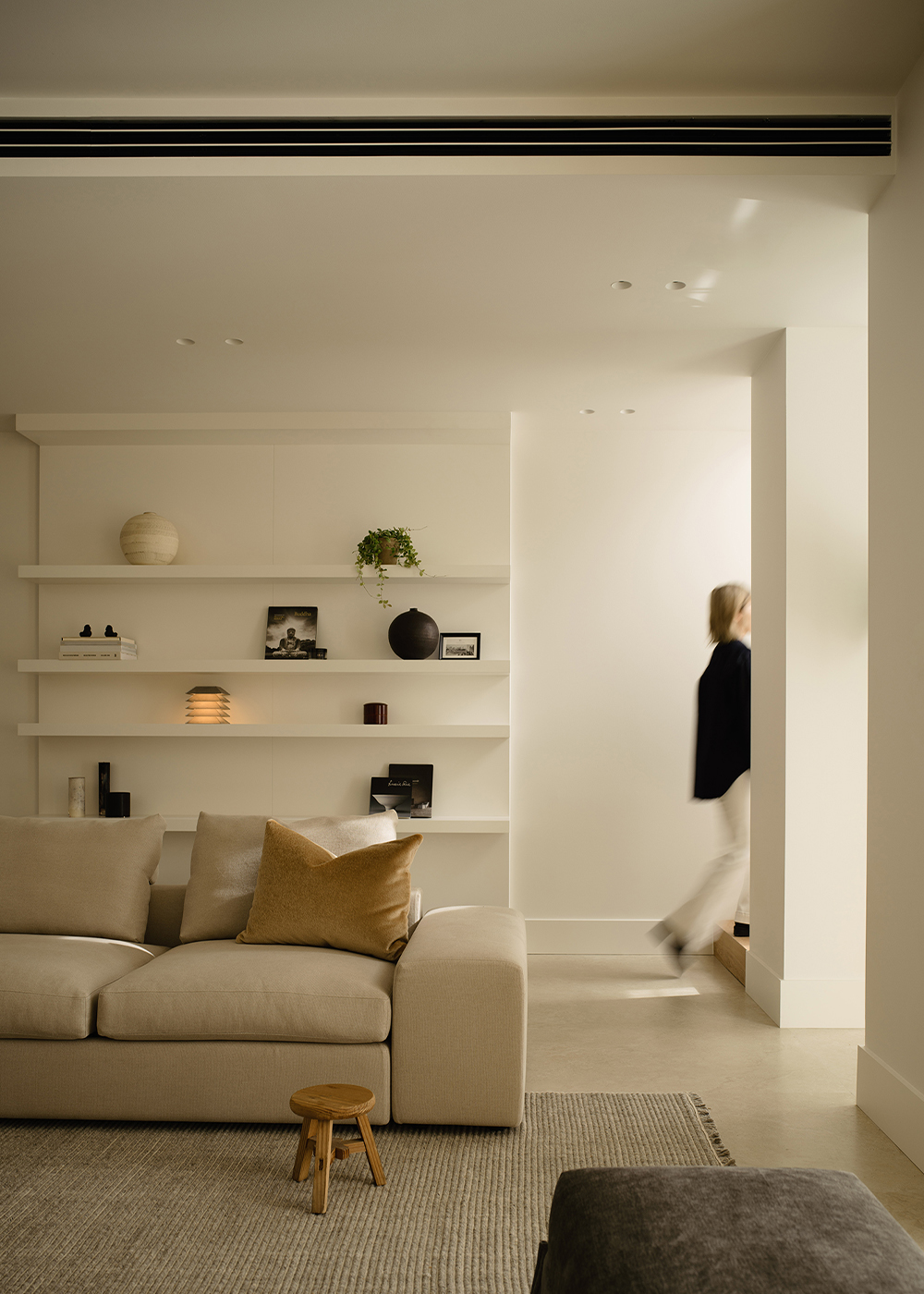
A seating area is embedded between the island counter and the dining table. It is not assigned a specific functional definition, yet it allows for activities such as drinking tea, reading, waiting, and brief stops to occur. It serves as a pause in this circulation route and a transition from dynamic to static space. The circular dining table diminishes the sense of direction. Flos Skygarden, with its simple hemispherical form, seamlessly integrates into the space. The intricate embossed patterns on the interior are only revealed when one looks up - externally restrained, yet internally rich.
Materials constitute the true tactile essence of space. Natural wood and limestone establish the overall tone. Limestone, with its granular texture and natural pores, and natural wood, retaining its unpolished grain, together create a sense of authenticity that is "unsmoothed by fine decoration". They prevent the space from falling into the trap of "model room-style" smoothness and uniformity, and instead bring it back to a state where it can be touched, used, and gradually left with marks.
The bedroom does not emphasize its presence through stylistic language, but rather returns to more direct bodily sensations. Wood, fabric, and paint work together to create a serene enveloping feeling. Light slowly spreads between the curtains, floor, and fabric, allowing sleep, reading, and solitude to occur in a calm atmosphere. The daughter's room employs a softer and more rounded furniture vocabulary - the Vitra Panton Chair and a round velvet armchair enclose a small space belonging to the young occupants. The Akari paper floor lamp sits like a glowing object in the corner, and the gauze curtains filter the sunlight into a diffused glow. There is no deliberate feminine styling, but rather, the furniture and tactile elements themselves echo the lightness of this age group.
The other bedroom is reserved for the occasional visit of the son. On the same hard furnishing base, the differences in soft furnishings and furniture reflect the personalities of different occupants - this is the greatest flexibility left for this residence: it allows the users to grow over time. Exquisite proportional relationships and pragmatic functional planning constitute the rational framework of the space; aged wood, cotton and linen fabrics, and collected artifacts allow time, touch, and human atmosphere to slowly permeate.
This residence does not adhere to a predetermined style, nor does it pursue fleeting visual impressions. Beyond the hard decor, circulation, and materials, we deliberately retain a significant amount of "white" - empty walls, empty corners, and undefined transition areas. These are not absences in design, but rather spaces reserved for the family's future life.
公开 不公开