Nowadays, "ancient towns" and "ancient streets" have become a cliché promoted by urban administrators, seemingly a standard feature of every city. Yet Lizhuang in Yibin, Sichuan, is like a calm and composed child, nestled in the embrace of the Yangtze River, its mother river, in a peaceful slumber. Is it truly free from care? Far from it. It simply boasts three unparalleled strengths: being the first ancient town along the Yangtze River's thousands of miles, a time-honored tradition of valuing education and literary heritage, and a profound academic atmosphere coupled with an indomitable wartime spirit, fostered by the numerous academic institutions that relocated here during the War of Resistance against Japanese Aggression.
During the war, Liang Sicheng and Lin Huiyin, two preeminent architects with profound knowledge of traditional Chinese construction, led the Society for the Study of Chinese Architecture to take refuge in Yueliangtian of Lizhuang. Once, this area was a network of water streets spanning about 60 mu, connecting residential halls and courtyards for living and socializing. In 2023, the Lizhuang Ancient Town Administrative Committee, in collaboration with relevant real estate development and operation institutions, jointly planned and constructed the Yueliangtian Scenic Area – a water town with two above-ground floors, imbued with the charm of traditional Chinese architecture. The project aims to redefine the "habitation" model under the guidance of "new folk customs" by integrating the crisscrossing water systems with the Confucian culture of "rites". Thus, Qilai Manor, a complex with neo-Chinese characteristics, came into being at the right moment.
When Li Xue, Design Director of Chengdu Runshe Natu Design, received the commission for Qilai Manor, the estate was already a complex of traditional Chinese wooden structures: time is embedded in the ancient wooden beams and columns, and a distinct ritual order unfolds in the spatial pattern of the "four waters converging into the hall" courtyard. However, the designer keenly identified the architectural flaws: irrational functional layout, scale and proportion, lighting, and equipment configuration, which rendered it unable to meet the operational demands of a contemporary hotel.
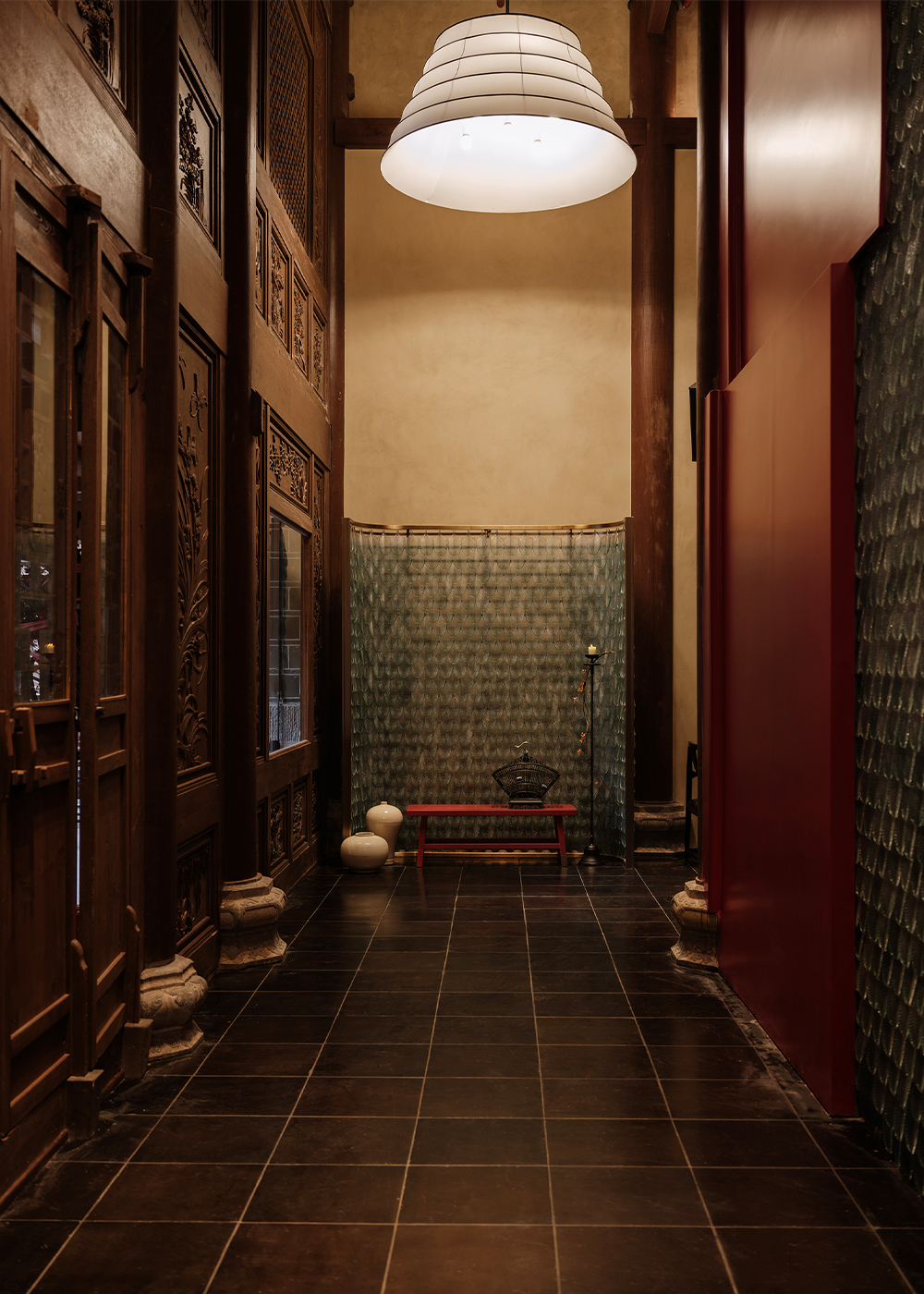
It was then that the designer conceived an innovative solution: relocating the hotel's internal dining and social spaces to form independent functional zones, including a ritual hall, tea house, banquet hall, temporary accommodation supporting the ritual space, exhibition and sales area, and pure homestay units. These spaces coexist in a parallel and collaborative manner, creating a new modular layout for hotel spaces. This design not only addresses the architectural deficiencies but also optimizes functional allocation to adapt to modern hotel needs.
She tackled the original space's poor lighting and depressing color palette by introducing natural light and translucent materials such as glazed glass, crafting light and shadow effects that evoke Oriental artistic conception. She reshaped the building's "inner skin" and spatial atmosphere, preserving to the greatest extent the original wooden architectural charm and cultural connotation of Qilai Manor, and forging a space of profound Oriental aesthetic value.
Guided by this philosophy, the designer embarked on a visual narrative journey at Qilai Manor through the lens of Oriental aesthetics: First, in the grand ritual and banquet hall, the designer drew inspiration from the form and color of traditional Chinese clothing to create a cinnabar-colored front-opening screen. More than a visual focal point, it is the embodiment of the ritual spirit of the entire space. Here, the volumetric sense of the screen echoes the "front-opening" style of traditional Chinese garments – symmetrical, solemn in its opening and closing.
This is by no means a simple appropriation of form, but an innovative approach that transforms the etiquette of dressing into the ritual of space. Second, the screen is adorned with hollowed-out copper coin patterns reimagined through modern composition. The repeated and continuous motifs form a rhythmic texture, achieving the Oriental spatial principle of "separation without isolation". Light and sight penetrate freely, maintaining the hall's overall transparency and airiness, and enlivening its spatial layers.
Finally, in the outdoor waterways of Qilai Manor, The architect constructed the "Three Wishes Stone Arch Bridge". Leveraging the fragmented light and shadow cast by water, she crafted a poetic artistic conception – water becomes a medium, a soft bond connecting the buildings across the stream, creating reflections, refractions, fluidity, and ethereal visual effects that blur the boundary between reality and illusion. Serene and mysterious, it evokes a sense of "joy within the chamber". The land, our earthly abode, is transformed into a series of islands, creating a relationship of "this shore and the other". This redefines the spatial rhythm and circulation paths, turning the entire first floor of Qilai Manor into a fluid corridor where indoor and outdoor spaces, and scenery, blend and transition freely.
As a public space, it is inherently commercial, and thus the designer bears an unshakable responsibility for its long-term viability. Design must be developed and executed in accordance with commercial logic. Li Xue firmly believes that the success of a commercial space lies in balancing the "everyday" and the "extraordinary", and grounding commercial operations in the "ordinariness" of daily life – this is the right path.
When contemplating the underlying logic of Qilai Manor, the designer had a clear insight: the ritual sense of classical "rites" alone cannot support the estate's commercial operation; it can only serve as a marketing "event" to drive traffic to the homestays. From the very beginning of defining the business model, she focused on building a commercial closed loop centered on the homestays, and on this foundation, integrated the ritual sense of "classical weddings" to create a unique selling proposition.
First, the designer established a "dual-cycle system" for Qilai Manor's operation, encompassing daily consumption and ancient ritual-based consumption, ensuring a balanced revenue stream. Second, the meticulous handling of ritual elements in the manor reflects the designer's balance between ceremonial etiquette and daily consumption. Thus, Qilai Manor not only meets people's daily consumption needs but also fulfills the desire for classical ritual experience – truly revealing the extraordinary in the ordinary.
In the spatial design of Qilai Manor, Li Xue employs neo-Chinese techniques yet brings a fresh perspective – her design transcends the superficial interpretation of "decorativism" in soft furnishings. Instead, it focuses on the relationship between space and human movement, the integration of indoor and outdoor environments, and the interplay between the experiences people have and the subtle regrets that add depth to the journey. Her work reveals the vibrant vitality and boundless potential of Oriental aesthetics in the contemporary era.
公开 不公开