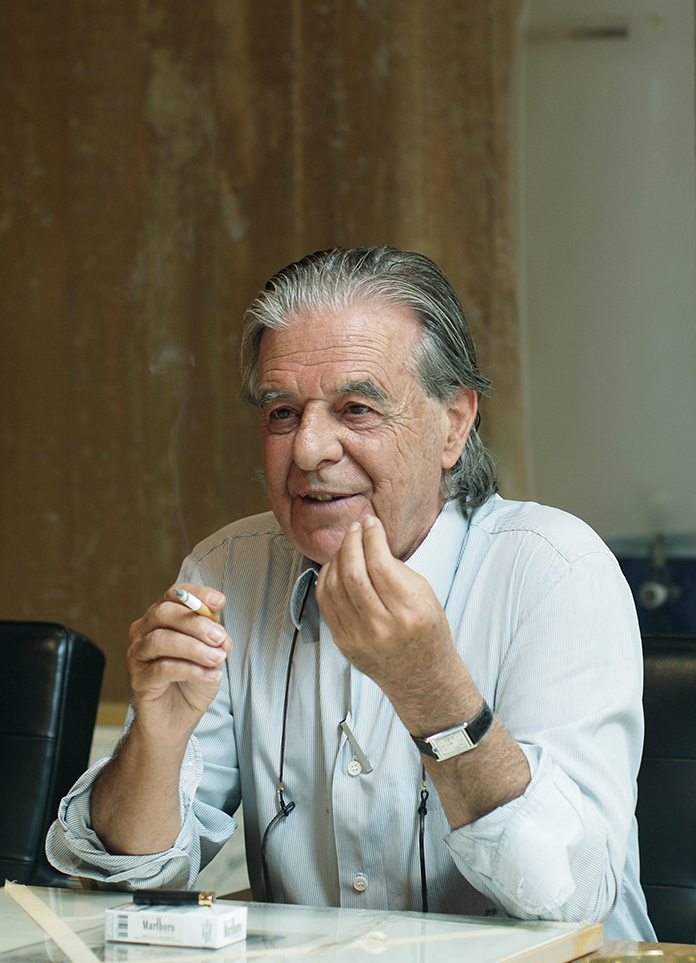
During the communication with Arthur Casas, they informed us: "Since the establishment of the firm in 1990, the factor that has supported our continuous progress is not a fixed form of language, but a working method that has persisted until now: starting with listening and replacing updates with responses. We have always regarded climate, landscape, light, culture, and human lifestyle as the initial clues for design. Buildings should not exist as "objects" detached from the environment, but should emerge naturally as a result of the natural conditions of the site." Regardless of the scale changes, from residences, hotels to furniture and urban projects, they have always been concerned with the same issue: how to improve people's real and specific daily lives through the organization and perception of space.
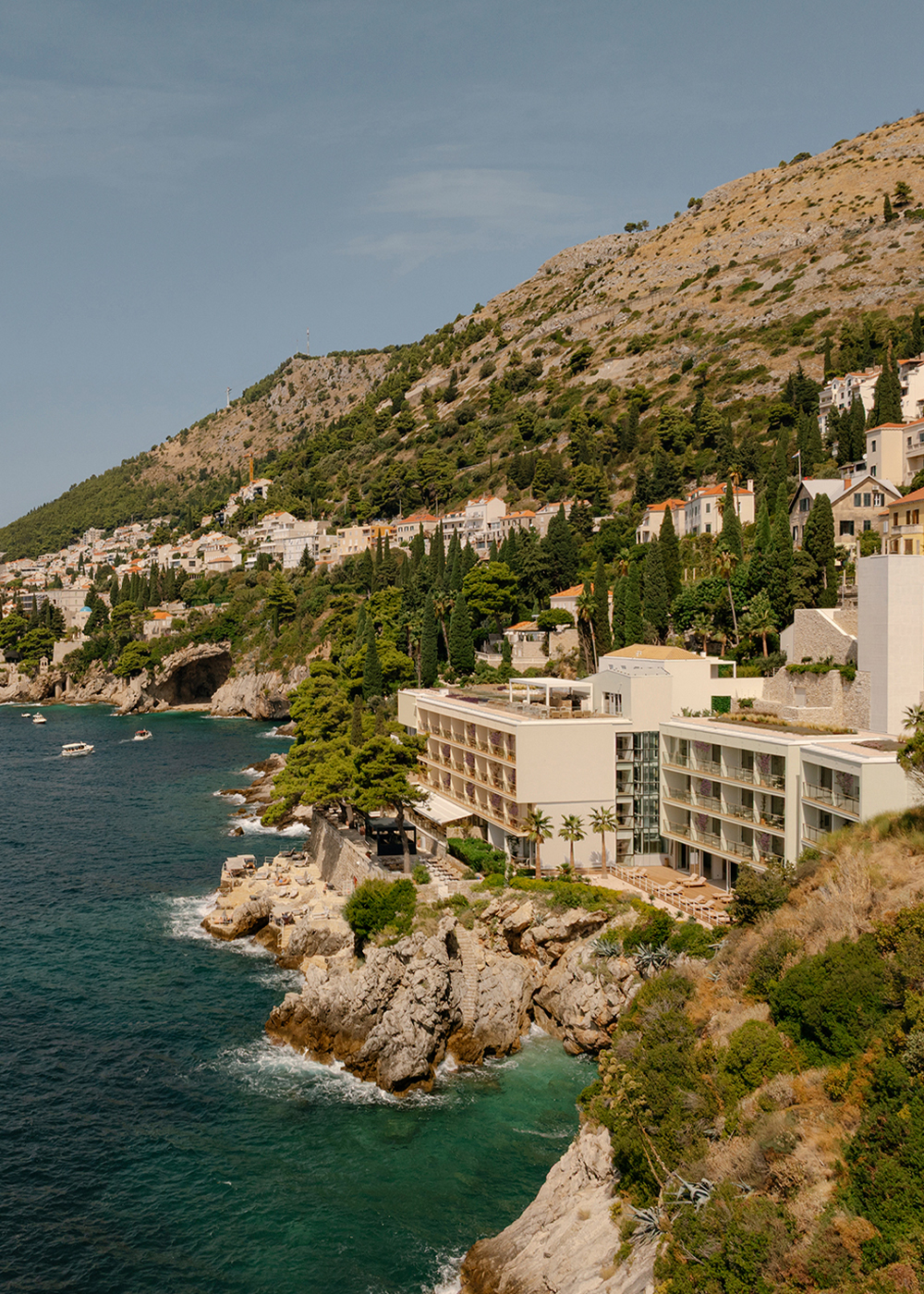
Set at the base of a cliff with direct views of the Adriatic Sea and the walled city, Hotel Villa Dubrovnik is a hospitality project that translates the relationship between landscape, history, and contemporaneity, integrating itself into the natural and urban context of Dubrovnik, Croatia. The original building, constructed in 1961 as a residence for the political elite and converted into a hotel two years later, is part of the city's skyline and protected for its integration into the landscape — a condition that limits any intervention on the facade in terms of color, volume, or texture.
The hotel's management sought an aesthetic renewal capable of repositioning the property internationally as a distinguished option within the excellence standards of the Leading Hotels of the World. The choice of a Brazilian studio stemmed from the desire to introduce a new perspective associated with the energy and inventiveness of contemporary Brazilian design, while preserving the authenticity of Croatian culture from an external point of view. Transformations were therefore focused on the interiors, fully redesigned by Studio Arthur Casas to reinterpret local identity through a contemporary lens.
The concept emerges from the reading of Dubrovnik's modern "golden age," between the 1950s and 1970s. During that period, the city became one of the most cosmopolitan destinations in Eastern Europe - a symbol of elegance, with a vibrant social and cultural life shaped by the legacy of Venetian and Italian influences that define Dubrovnik's identity. Its singular medieval architecture on the coastline, marble-paved squares, and curved ornamental forms - key elements of the history of the Dalmatian coast - served as inspiration.
Conceived from the outside in, the material palette reflects the vernacular building traditions that correspond to Dubrovnik's geography and culture. Croatian limestone and stucco evoke the region's historic architecture, while Croatian oak — one of the country's main exports — appears in panels, millwork, and built-in furniture. In counterpoint, Via Appia stone from Brazil introduces an authorial layer with a subtle touch of Brazilianness and reinforces the dominant earthy tones. The chromatic palette is derived from the surroundings: whites, sands, and beiges from the local stone combine with the green of the vegetation and the warm terracotta of the Old Town's rooftops.
The distribution of the program follows the natural slope of the site, unfolding from top to bottom. The common areas underwent a complete reconfiguration of flows, resulting in more fluid and integrated spaces aligned with the existing architectural structure. Access occurs from the highest level, where the Galanto rooftop bar is located. On the intermediate level sit the reception and the first guestrooms; below them, in addition to the suites, are the spa, gym, and the restaurants — Giardino, by the sea, and Pjerin, Michelin-starred.
On this same main floor, the Library Bar connects to Restaurant Pjerin in a single spatial gesture. The environment, clad in wood and stone from floor to wall, houses a book collection and a pair of mannequins dressed in traditional Croatian attire — scenographic elements that subtly evoke local memory. This layering of cultural and design references synthesizes the spirit of the project, which values a sense of permanence.
The 56 suites and two private villas are distributed across diverse typologies that optimize circulation and frame the landscape. All layouts were redesigned to make the most of surrounding views, creating a visually connected and sensorially expanded experience. In the private areas, light and neutral finishes contribute to a perception of openness.
Suite millwork — wardrobes with perforated, layered panels — and the circulation carpets — intentionally aged to feel as though they have always been there — incorporate graphic patterns created by the Studio, directly inspired by the country's traditional lacework, recognized by UNESCO as Intangible Cultural Heritage of Humanity since 2009. These artisanal references, embedded in wood and textiles, reinforce the link between materiality and local culture, preserving visual coherence and a sense of warmth in the interiors.
The fluidity between indoor and outdoor spaces, reinforced by direct contact with the greenery, enhances the sense of place and deepens its integration with the local context - a recurring element in the work of Studio Arthur Casas. Each room features a bougainvillea, ensuring blooming during peak season and establishing a direct link with the Mediterranean setting.
The indoor pool opens to the exterior, where lighting plays a fundamental role in shaping a soft atmosphere: light sensors adjust intensity according to circadian rhythm. At the lowest level of the site, the hotel offers direct access to a private beach.
Villa Dubrovnik exemplifies a methodological approach to interior design within environmentally and landscape-restricted architectural contexts. The integration between program, materials, and furniture — in dialogue with the topography and preservation guidelines — reflects a balance between contextual continuity and contemporary design practice, allowing the landscape to become the structuring element of the project.
公开 不公开