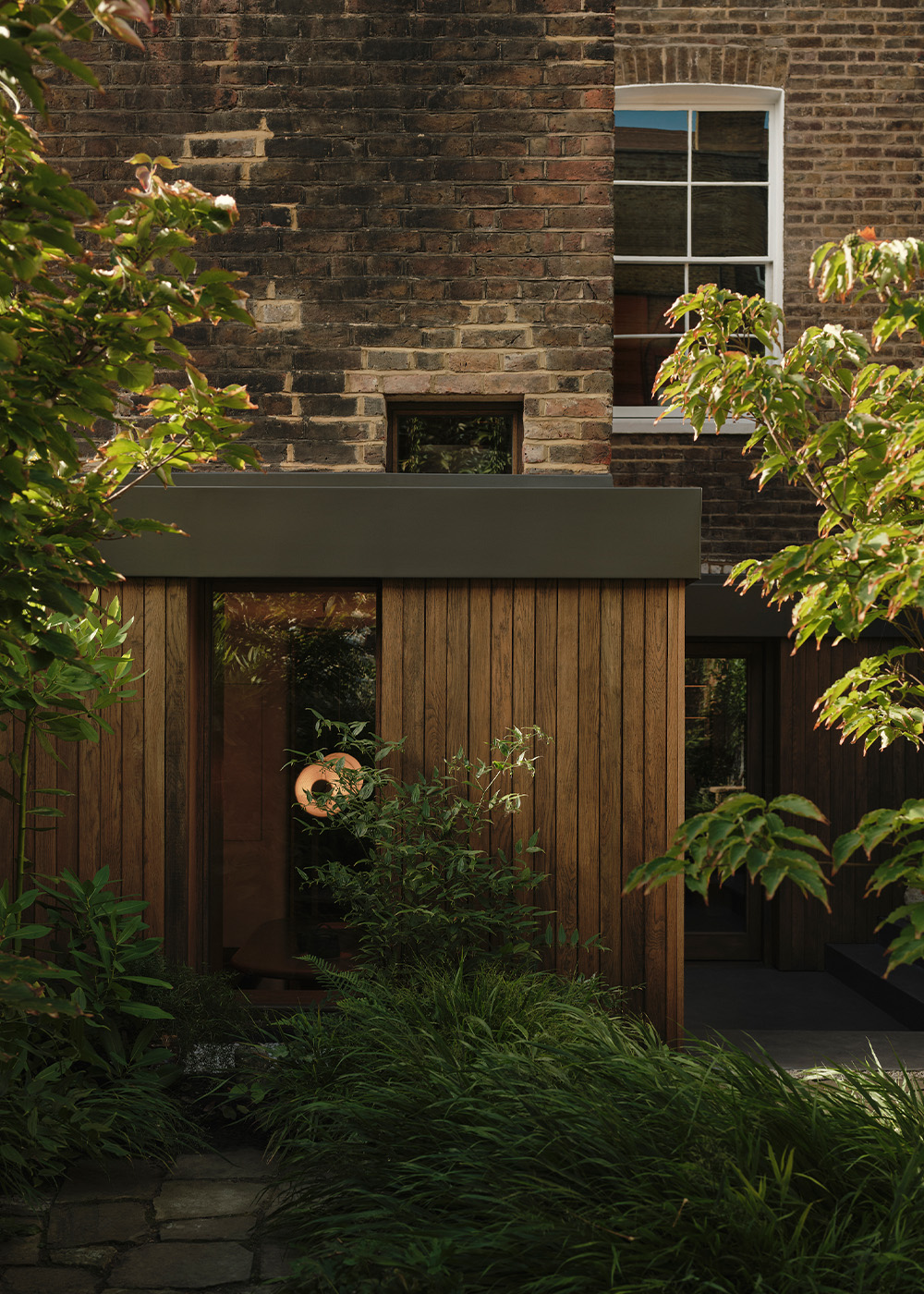
The property stands at the end of a terrace overlooking a leafy garden square in Islington, just north of the City. Arranged over three levels, the property suffered from a constrained collection of small, dark rooms and years of neglect. Studio Hagen Hall was briefed by the clients – a couple – to revive the tired property, delivering a forever home perfect for two, featuring dedicated space for the clients’ growing collection of Japanese and self-made ceramics, furniture and artwork.
When discussing Heion House, Studio Hagen Hall mentioned the word "moderation". In their opinion, when dealing with a Georgian-style row house with a rich historical layer, the starting point of the design is not creation but understanding: understanding the proportions of the space, the texture of the materials, and the traces that time has subtly etched. "Knowing when not to design is just as important as how to design," the studio said. At the same time, they also emphasized "reversibility" as a more long-term responsibility. All interventions should not be the "end of history", but should leave the possibility of re-interpretation for the future. Therefore, in this project, the new spaces do not replace the old ones; instead, they exist in an embedded and attached manner, allowing the building to be updated while continuing its existence, and history is re-read in the present.
In terms of the specific spatial strategy, Studio Hagen Hall did not adopt a strongly form-driven approach but chose a more restrained path - as if "furniture" were placed within the building, subtly reshaping the spatial boundaries through fine woodworking. During the conversation, they told us that this is not only a technique but also an intervention method, especially suitable for historical buildings that cannot be extensively modified. At the same time, they also mentioned that the atmosphere of the space can be established through the progressive interplay of light and shade and material texture: light is consciously confined, shadows are extended, and dark wood and leather present a gentle and stable tactile sensation in low light. In this balance of restraint and delicacy, Heion House gradually reveals a serene temperament that integrates modernism with Japanese aesthetics.
The entire layout of the home has been reconfigured, favouring a more connected and multi-use arrangement. The property previously offered three bedrooms, but with no children or guests to host regularly, the plan has been adapted for the couple’s leisure time and artistic pursuits. Most notably, the primary bedroom (previously on the first floor) was relocated to the upper-ground floor, with the main.
On entry, visitors are greeted by a hallway complete with a Genkan (a traditional Japanese entryway step for the removal and storage of shoes to avoid bringing dirt into the house), where slippers await guests. A new primary bedroom suite, consisting of a dressing room and bedroom separated by a floor-to-ceiling height sliding panel, occupies the former lounge. Custom in-built joinery in smoked oak, designed by Studio Hagen Hall and fabricated by TG + Co. (a long-time collaborator of the studio), sits lightly inside the historic building fabric, enveloping the room on all sides.
Original elements of the house, such as the skirting boards, architraves and previously covered-up fireplace, were lightly treated rather than fully restored to acknowledge the different design eras. Following a small step change on the split level plan, visitors are drawn through the hall toward a modest bathroom of white mosaic tiles, microcement, oak, unlacquered brass hardware and a curved shower wall. A small window at floor level, visible all the way from the entrance hall, creates a new visual connection through the bathroom to the garden beyond.
On the lower ground floor is the snug. A Tokonoma 床の間 (a recessed niche designed specifically for displaying flower arrangements and art) welcomes you on entering the space. The room is again lined in joinery, with inbuilt leather single-bed sized sofas on two sides, creating a space to relax and enjoy the concealed TV, or convert into an extra sleeping space for guests. Integrated storage within the built-in sofa provides room for bedding and blankets. Moveable textured glass panels framed by a grid of shelves (evoking traditional Japanese Shoji screens) filter light between the snug and kitchen, offering display space for the clients’ ceramics, and a way for conservation to flow between the two rooms.
In the kitchen (a bespoke design by Studio Hagen Hall) every inch of space has been designated either for utility or atmospherically lit display areas for a growing ceramics collection. Nestled inside the confines of the original kitchen, the newly configured space acts as a highly functional piece of furniture that leads seamlessly out into the lower garden courtyard - now a “room” in its own right - with the timber and microcement floor finishes tying the two together.
Upstairs on the top floor is the main living space, previously the primary bedroom and now nicknamed the ‘salon’. Spanning the front width of the home, and making the most of the southern light, views over the treeline and square outside, the salon is complete with armchairs by David Horan and antique Japanese furniture collected by the owner, as well as in-built shelving and storage for art.
Studio Hagen Hall has worked with every available inch of the property to give the occupants a unique and highly personal home, one that considers them right down to the very last detail. The project is an exemplar in blending disparate worlds and cultures, finding harmony through a commitment to heritage, craft, and nature.
公开 不公开