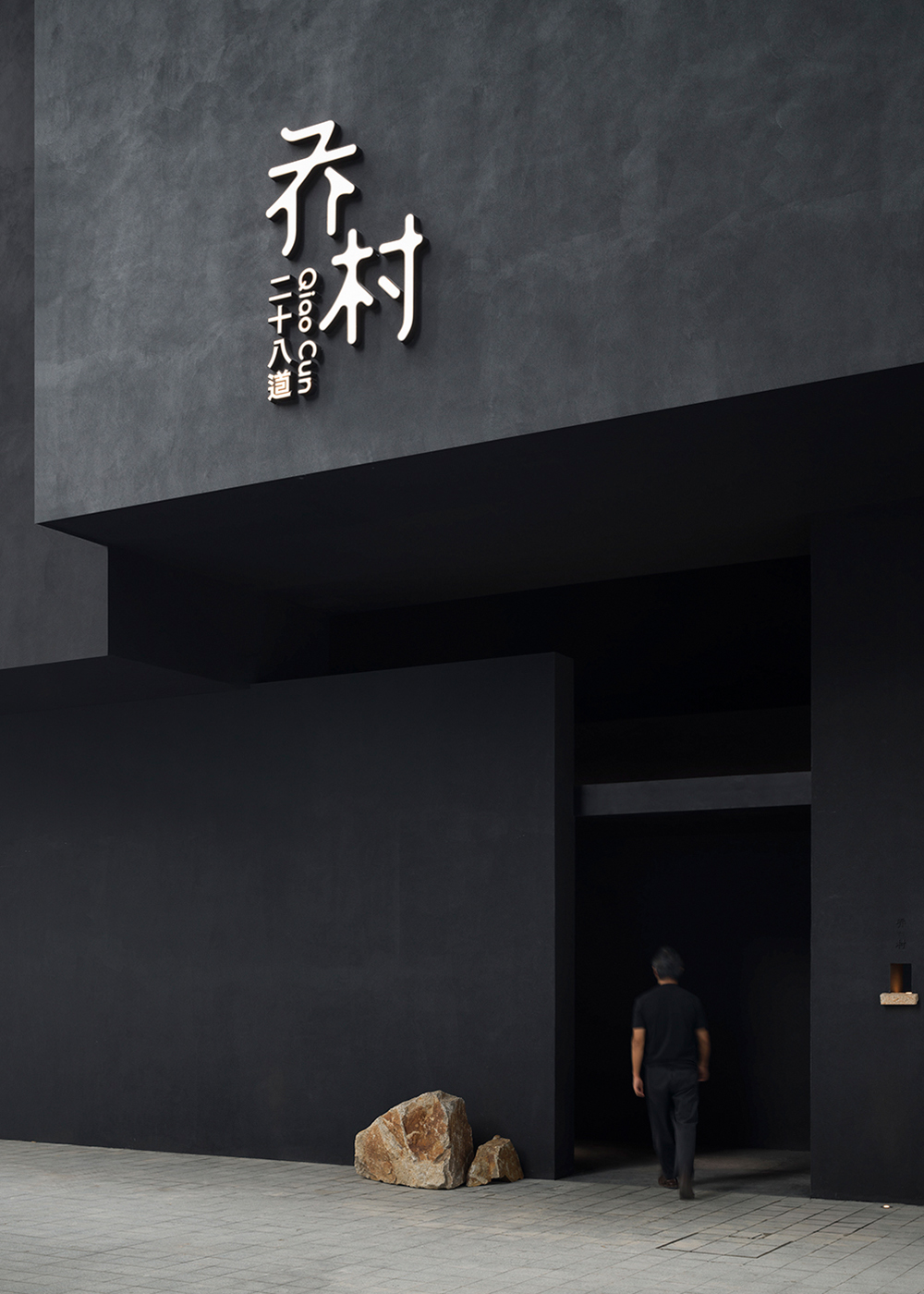
In the bustling heart of Qianjiang Century City, a building assembled from stacked black boulders stands quietly, shutting out the clamor of the city.
Between the two buildings, the elevated corridor serves as the restaurant's main passage, doubling as an indoor courtyard. Guests step onto a shallow water walkway about 15 meters long, where the water surface meets the walkway with a height difference of only 10 centimeters. The black stone at the bottom of the pool mirrors the skylight and the reflections of passersby. Passing through the corridor, one enters the lobby with its 8-meter-high ceiling. A square open skylight hangs above the water feature, with a natural stone slab resting directly beneath it. Water flows down along the edges of the skylight, striking the stone surface, and the crisp sound of water forms a continuous whisper in the vast space.
Beyond the water feature lies the reception lobby. The heavy natural stone slabs contrast sharply with the black textured-paint walls — the stone raw and primitive, the walls matte and serene. The two materials stand in opposition yet converse, setting the tone of the space: restrained wildness, refined ruggedness.
Enclosed by heavy, dark walls lies a tranquil tea room. Artificial overhead light mimics daylight, casting a soft glow in the dimness. Wood, clay, plants, and calligraphy — with minimal furnishing — create a Zen atmosphere of emptiness and simplicity, drawing inward to settle the body and mind for a quiet tea ceremony.