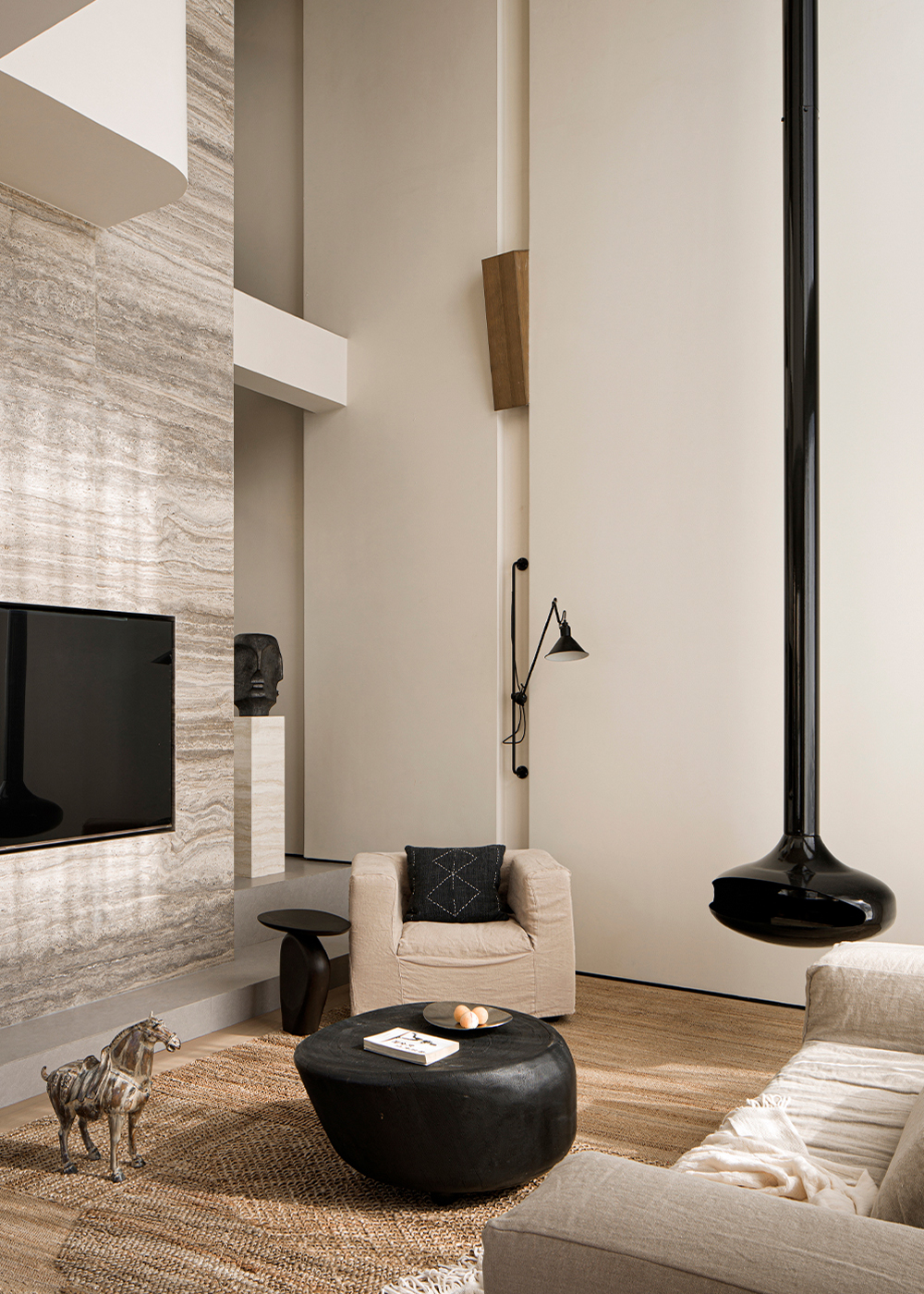
"The core of our design is the scenes of life." This project reconfigures spatial relationships to foster family interaction, not stylistic expression.
The living room's double-height volume is repositioned to open a visual corridor between the second-floor family room and the ground floor, allowing children and adults to maintain eye contact across levels—perceptual co-presence that dissolves physical separation.
The staircase is reshaped as an independent sculptural element, a visual anchor whose sightlines with the living room are calibrated so that daily movement naturally blends into living scenes.