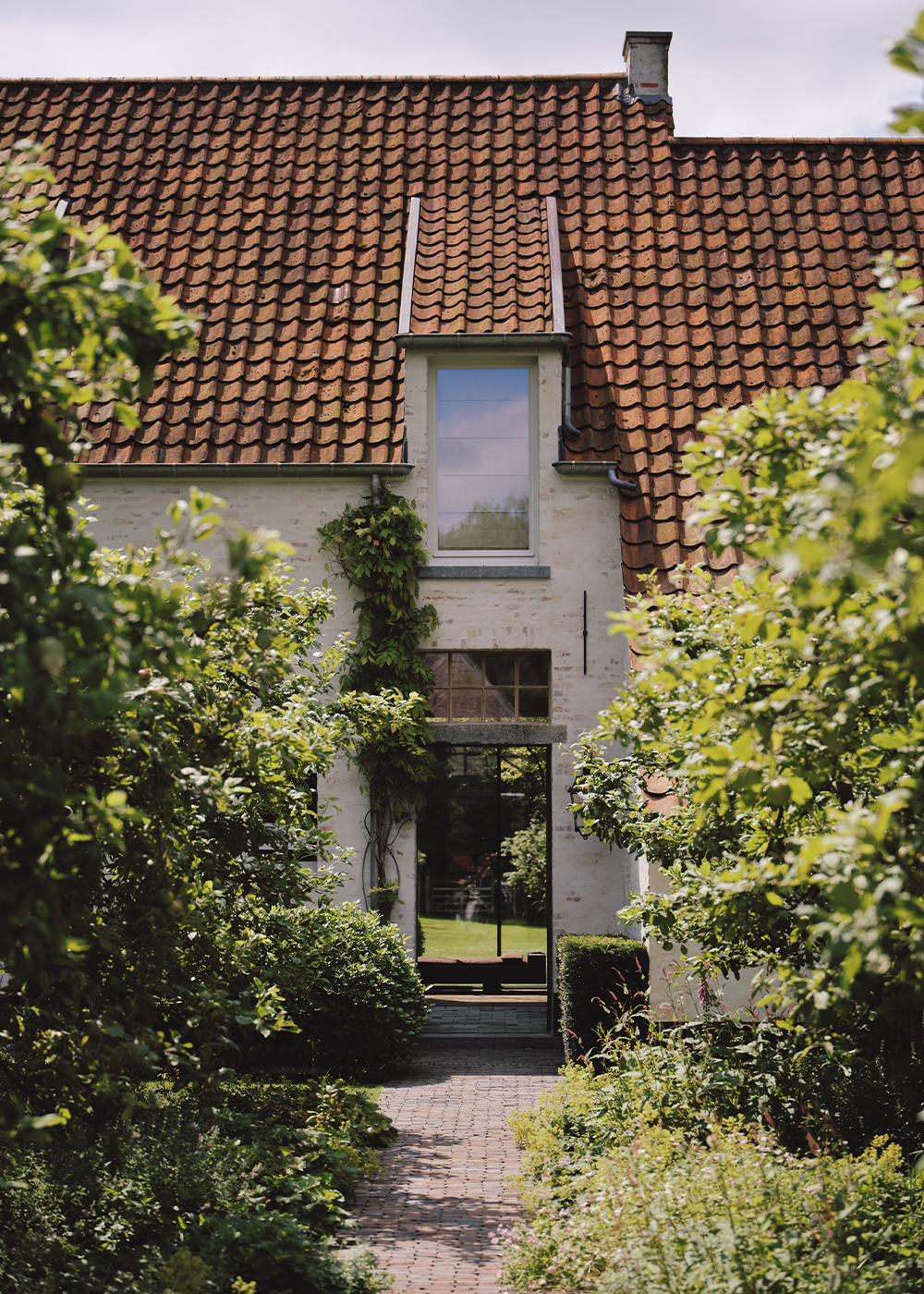
Belgium in July, sunlight filtering through thin summer clouds, falling upon a quiet villa neighborhood in Schilde. We followed a straight path into the garden, flanked by two rows of apple trees laden with red-and-green fruit. At the end stood a house with a red-tiled roof and mottled warm-white brick walls, as if it had grown naturally from the earth. The artist Annelies Toussaint and her husband greeted us at the door with smiles. The whole scene carried the faint sweetness of ripening fruit; a simple, abundant vitality gently enveloped us.

Stepping into the foyer, a quiet light streamed in through the floor-to-ceiling windows opposite, framing the greenery of the back garden into a breathing painting. The beige walls bore a coarse handmade texture, upon which hung Annelies' linen textile works—fiber and mineral murmuring to each other. This house was not designed by an architect; Annelies and her husband drew the plans themselves, then handed them over to an architect to realize. "I need quietness in my life." It was a phrase Annelies repeated in almost every room. This yearning for peace became the core spatial language of the entire home.

Every material in the foyer has a story. The walls carry a warm beige tone. Disliking the starkness of white wall, Annelies crushed mineral stones she found in the garden into granules and mixed them into the wall paint, creating a texture unique to this place. The corners were gently rounded off, making the space flow more softly. Most of the wood is between one hundred and seven hundred years old. The oak floorings underfoot came from leftover materials after a castle renovation, still bearing visible marks of age; the grey floor tiles, varying in shade, were originally red from a 15th-century church, baked twice to achieve the quiet grey tone. And yet this house, full of timeworn character, is only built four years ago. Beneath its weathered surface lie efficient insulation, underfloor heating, and heat-deflecting glazing—an advanced modern core wrapped in an timeworn shell.
Annelies is a textile artist. Her works, like her home, radiate warmth and tranquility from within. Her embroidery is inspired by a 17th-century Japanese technique called Sashiko, originally used to reinforce fabric, which she has transformed into a pure artistic expression. The base fabric is antique linen, one hundred fifty to two hundred years old. Because looms of that era had limited width, the cloth is pieced together from narrow strips, and the fine seams are left openly visible, becoming the time rings of the work. She calls her practice "slow art": every stitch is a meditation, every layer a healing.

In a corner of the foyer, she held a stack of linen pouches. Gently opening one, she revealed the creative memories stored inside: a small jasmine scent, a handwritten poem, a hand-made color chart. The corresponding artwork, titled Blanco, comprises twenty layers of beige pigments in different tones. That afternoon of creation, the garden was full of blooming jasmine, and Annelies felt an empty yet full peace within herself—so she stitched that emptiness into the fabric. Each of her works comes with such a pouch, preserving both inspiration and the inner journey.

Turning right into the living room, a profound quiet filled the space. The black daybed under the windows, the coffee table pieced together from old planks, the stone fireplace—all were designed by Annelies and her husband. ‘I found a stone, so I made a fireplace for it,’ she said. Unable to find an ideal solution for the television, she and her brother designed a taupe suede sofa that opens and closes by remote control, discreetly hiding the TV. When the screen disappears, the room returns to its undisturbed quiet. She shared a simple but firm belief: "If you can't find the ideal product on the market, design it and make it yourself."

The kitchen, keeping within the home's quiet warmth, incorporates large areas of black. The cabinet doors, of natural black leather, are warm to the touch. The refrigerator, oven, and other appliances are hidden away in a separate internal room, eliminating noise and visual clutter. The window openings curve gently inward, avoiding harsh angles and welcoming more natural light. Through the glass doors, a black metal pergola covered in green vines extends into an outdoor dining area. Annelies invited a young man from Ghent to bake fresh Belgian waffles and Dutch mini pancakes for us in the garden, as the coolness of iced tea drifted through the summer air.

The bedroom unfolds beneath a pitched roof. The walls fade in a gentle gradient from white to a faint dusky tone, as if dusk were about to settle, wrapping rest in a softer garment. Annelies made two white clay pendant bedside lamps, warm and gentle as the moon. The bed faces the back garden, the windowsill deliberately lowered. What she enjoys most is waking in the morning, seeing a view full of green without getting up. On weekends, her husband brings her coffee, and she lies back watching the squirrels and birds busy in the trees outside—a quiet, steady happiness, like the fine stitches on linen.

At the end of the garden, a standalone house quietly nestles in the greenery—Annelies' studio. In front of the garden-facing window sits her embroidery worktable. Making by hand, facing the turning seasons—that, to her, is the best way to work. The wall paint is mixed with straw fibers, giving it a soft, striated texture. The washbasin is an ancient stone, and she designed the faucet to match.

At the worktable, two-hundred-year-old linen is stretched onto her handmade frame, stitched with quiet patience. A large-scale work can take two hundred hours—not work to her, but a silent meditation. Along the wall, colorful jars hold pigments from nature: soil, stones, a particular colored stratum picked up on a trip. Her husband laughs that the car always returns much heavier. She keeps a test notebook, meticulously recording where each material was found, its geological layer, and how it was prepared—dried, crushed, mixed with alcohol and water, then tested in little sketches. Every page is a diary of the earth.

To one side of the studio sits a tea table. Annelies has studied Chinese tea ceremony for ten years. Before becoming an artist, she ran the family textile business—a company of a hundred employees. Years of relentless pressure collapsed her health; a serious illness followed, lasting seven years, taking away her former life. After recovering, she studied Chinese tea with a tea sommelier and spent time in the mountains, walking daily in the forest. That deep connection with nature reawakened her creative inspiration, drawing her onto the path of art. And so, her work is inherently slow, meditative, and rooted in quiet stillness.

As we left, we walked back through the apple-filled garden. Summer breeze brushed overhead, and behind us the house held its silence. One of the designers with us described it as "so high, so close." Annelies Toussaint, with her hands, has gathered tranquility from earth, time, and hardship, and stitched it, thread by thread, into linen, stone, wood, and this entire home. Everything here points to a single word: peace—not the silence of seclusion, but a deep and luminous strength grown from within.

MORE PHOTOS