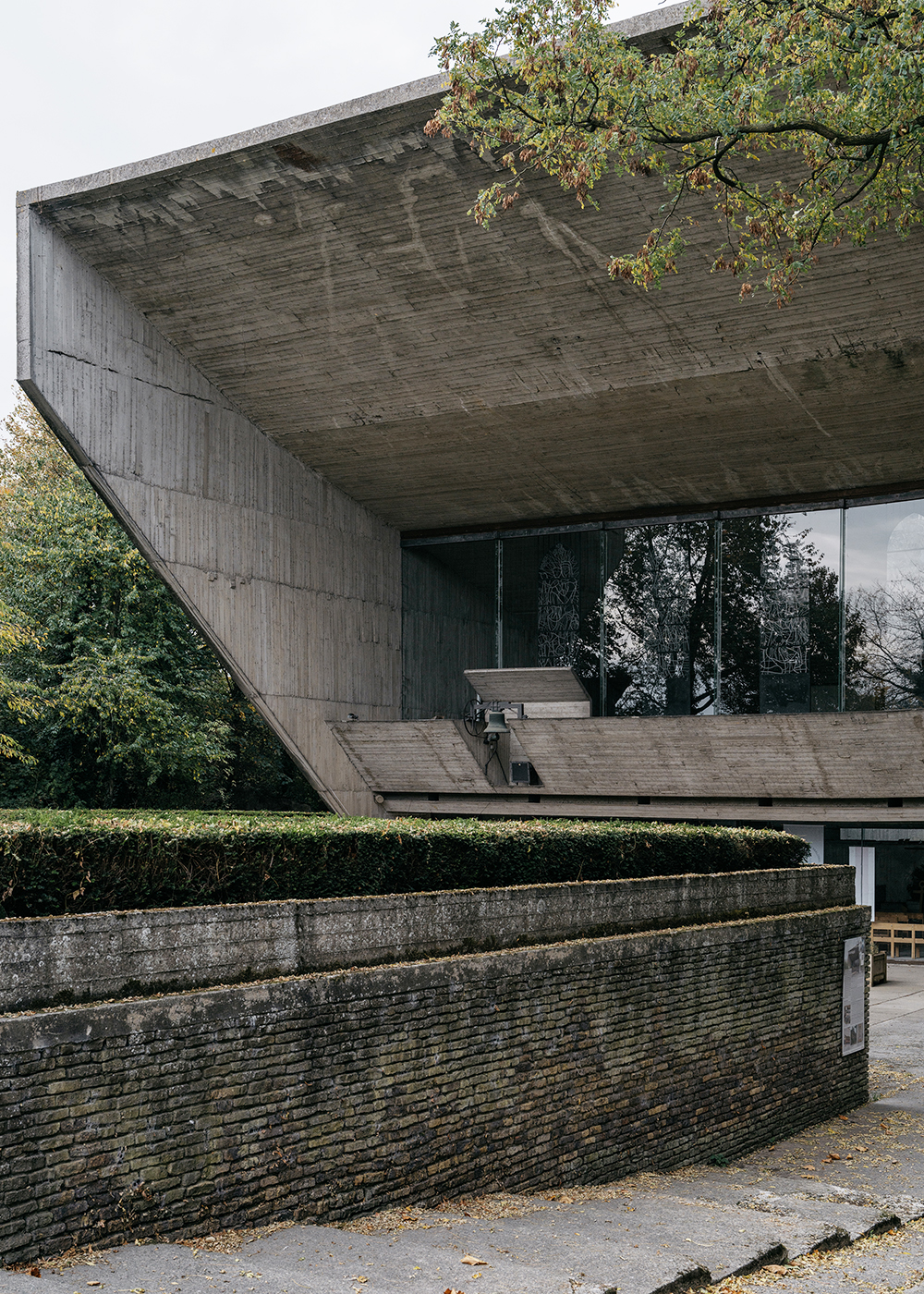
On this trip to Belgium, we ventured into East Flanders, heading toward an ancient pilgrimage site—the Chapel Kerselare. Belgium's weather has entered winter,we shivered as we reached the slopes of Mount Edegem .Walked through the woods. As the view gradually opened up, vast meadows spread out before us, and lying quietly upon them was this work redesigned by Juliaan Lampens. The church is low, slanted, and sharply edged—not at all a soaring gesture "pointing to the sky." Standing before the immense glass wall and peering inside, past rows of pews, we could see the altar standing silently at the very center.
The church's history dates back to the 15th century. Angelique Campens, a curator and art historian, told us the twists and turns behind it. The story begins with a crocodile. Legend has it that a nobleman, attacked by a crocodile in Egypt, made a vow to the Virgin Mary in his life-and-death moment: if he survived, he would build a church in his homeland. He returned safely, and the vow was fulfilled. A stuffed crocodile was thereafter suspended in this land far from rivers and deserts. Over time, the real crocodile was replaced by a wooden carving, yet it still records that miracle.
A devastating fire in 1961 brought designer Juliaan Lampens into contact with this church. He secured the design qualification in the open reconstruction competition, with the tacit approval of the church's pastor, the church became what it is today: cast in reinforced concrete. The massive sloping roof extends outward, forming a deep canopy. Unlike a traditional eaves, light and delicate, this is an entire tilted concrete slab, heavy and hanging overhead, sheltering pilgrims from wind and rain. Rainwater slides down the roof surface, and between the worship space and the offering area, a rectangular collection basin waits quietly—where the water lingers briefly, gathers, and then slowly drains away.